2D to 3D Surreal Street Photography
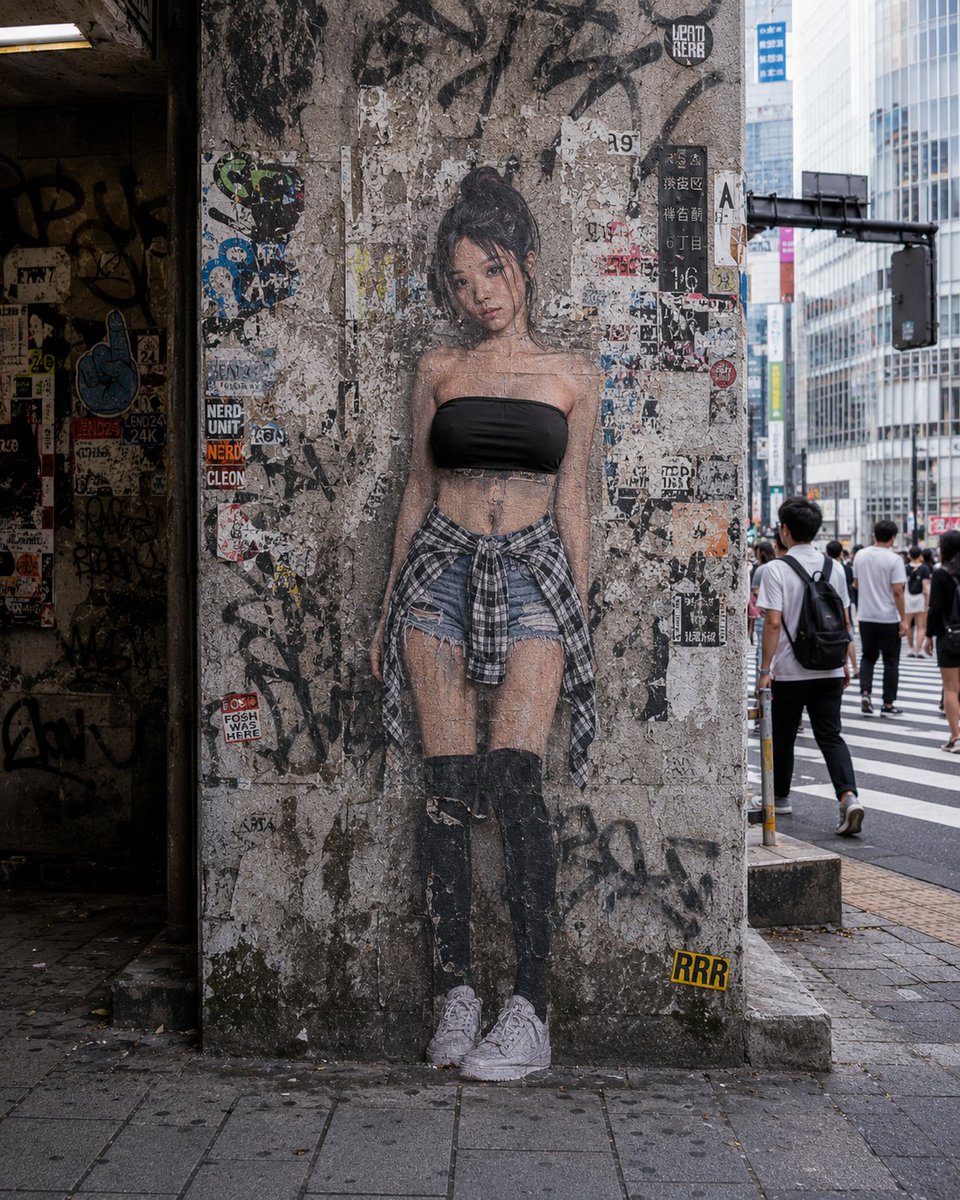
Full prompt
An {argument name="character setting" default="Asian adult female"} appears in {argument name="environment" default="Shibuya, Tokyo"}, close to or attached in front of a [background surface], using a front perspective, eye-level camera, and real street photography composition. The person's body is clearly divided into 2D and 3D states: the [2D body part] is a 2D flat printed image attached to the [background surface], while the [3D body part] suddenly turns into a real 3D human body starting from the [boundary position], entering the real space. The [2D body part] is completely a flat printed image, tightly attached to the [background surface], with no real thickness, volume, or protruding spatial structure. This 2D area presents the texture of real paper / poster / sticker / mural / wheatpaste poster, with a matte printing effect, slight fading, fine particles, paper fibers, aging marks, and edge wear. The edges of the 2D image can be slightly curled, peeled, or damaged, with visible glue marks, paste residue, torn paper scraps, or background texture in some areas. The texture of the [background surface] needs to show through or affect the 2D body area, such as concrete wall grains, brick wall gaps, metal plate scratches, old wood textures, graffiti marks, stains, cracks, sticker residue, etc., which should naturally blend with the 2D area of the character. The 2D body part should look like an image that has long been printed, pasted, spray-painted, or drawn on the background surface, rather than a real standing person. The [3D body part] suddenly transforms into a real 3D human body from the [boundary position], with complete real volume, anatomical structure, material details, light and shadow, perspective, occlusion, and physical contact. The 3D area should clearly enter the real space, forming a strong contrast with the 2D area. Skin, clothing, shoes, hair, accessories, or other body details should present hyper-realistic textures, with real highlights, shadows, folds, textures, and spatial depth. The [boundary position] between 2D and 3D must form a clear, sharp, precise, and visible boundary line. This boundary looks like a flat printed image and a real 3D human body being abruptly but accurately spliced together on the same body. The division cannot be blurred, gradient, or like a normal transformation or semi-transparent effect; it must clearly show: one side is a 2D flat image attached to the background, and the other side is a 3D body truly entering the real space. If there are graffiti, stickers, stains, cracks, spray paint, text, or other background elements in the scene, they can cover or press on the [2D body part], as if the background surface continued to be written on, spray-painted, or covered after the 2D image was pasted. Background elements should have a real surface relationship with the 2D body area rather than simply staying behind the person. The 3D body area needs to interact clearly with the real environment: if the [3D body part] includes feet, legs, hands, arms, head, or any body part sticking out, it must show real physical contact, shadows, occlusion, and spatial relationships. For example, feet stepping on the ground with slight pressure deformation; arms extending from the flat image, blocking the background and casting shadows on the wall or ground; the head protruding from the poster, with real facial volume, skin texture, and light/shadow structure. The overall style is surrealist real photography, maintaining the credibility of real street shots while strengthening the visual paradox of 2D and 3D body splicing. Lighting is [light condition], background is [background details], and the overall atmosphere is [visual style]. The image should have cinematic composition, high detail, real materials, real light and shadow, and real spatial perspective, hyper-realistic surreal photography, cinematic, photorealistic, high detail, 8K.
Original prompt
一名 {argument name="人物设定" default="亚洲成年女性"} 出现在 {argument name="场景环境" default="东京涩谷"} 中,靠近或贴合在 [背景表面] 前方,画面采用正面视角,眼平机位,真实街头摄影构图。人物的身体被清晰地分成二维与三维两种状态:[二维身体部位] 是贴在 [背景表面] 上的二维平面印刷图像,而 [三维身体部位] 则从 [分界位置] 开始突然变成真实存在的三维人体,进入现实空间。人物的 [二维身体部位] 完全是平面印刷图像,紧贴在 [背景表面] 上,没有真实厚度,没有真实体积,没有向外凸起的空间结构。该二维区域呈现真实的 纸张 / 海报 / 贴纸 / 壁画 / 麦糊海报 质感,表面具有哑光印刷效果、轻微褪色、细微颗粒、纸张纤维、旧化痕迹和边缘磨损。二维图像的边缘可以轻微翘起、剥落或破损,部分区域能看到胶痕、浆糊残留、撕裂纸屑或背景纹理。[背景表面] 的纹理需要透过或影响二维身体区域,例如混凝土墙的粗糙颗粒、砖墙缝隙、金属板划痕、旧木板纹理、涂鸦痕迹、污渍、裂痕、贴纸残留等,都应与人物的二维区域自然融合。二维身体部位应该看起来像是早已被印刷、粘贴、喷绘或绘制在背景表面上的图像,而不是一个真实站立的人体。人物的 [三维身体部位] 从 [分界位置] 开始突然转变为真实存在的三维人体,具有完整的真实体积、真实解剖结构、真实材质细节、真实光影、真实透视、遮挡关系和物理接触。三维区域应该明显进入现实空间,与二维区域形成强烈反差。皮肤、衣物、鞋子、头发、饰品或其他身体细节都应呈现超写实质感,拥有真实的高光、阴影、褶皱、纹理和空间深度。二维与三维之间的 [分界位置] 必须形成一条清晰、锐利、精确、可见的边界线。这个边界线像是平面印刷图像与真实三维人体在同一个身体上被突兀但准确地拼接在一起。分界处不能模糊,不能渐变,不能像普通变形或半透明特效;它必须明确表现为:一侧是贴在背景上的二维平面图像,另一侧是真实进入现实空间的三维身体。如果画面中存在涂鸦、贴纸、污渍、裂纹、喷漆、文字或其他背景元素,它们可以覆盖或压在 [二维身体部位] 上,像是在人物的二维图像被贴上或绘制完成之后,背景表面又被继续涂写、喷漆或覆盖。背景元素应与二维身体区域发生真实的表面关系,而不是简单地停留在人物背后。三维身体区域需要与现实环境产生明确互动:如果 [三维身体部位] 包含脚、腿、手、手臂、头部或身体某部分伸出,则必须表现真实的物理接触、投影、遮挡和空间关系。例如脚踩在地面上,鞋底有轻微受压形变;手臂从平面图像中伸出,遮挡背景并在墙面或地面投下阴影;头部从海报中探出,具有真实面部体积、皮肤质感和光影结构。画面整体风格为 超现实主义真实摄影,既要保留现实街拍的可信度,又要强化二维与三维身体拼接带来的视觉悖论。光线为 [光照条件],背景为 [背景细节],整体氛围为 [视觉风格]。画面应具有电影感构图、高细节、真实材质、真实光影、真实空间透视,hyper-realistic surreal photography, cinematic, photorealistic, high detail, 8K。
Use this prompt in the VdoBloom image editor.
Opens the image editor with this prompt — add your own photo to generate.