3D Isometric Block Art Reconstruction
Full prompt
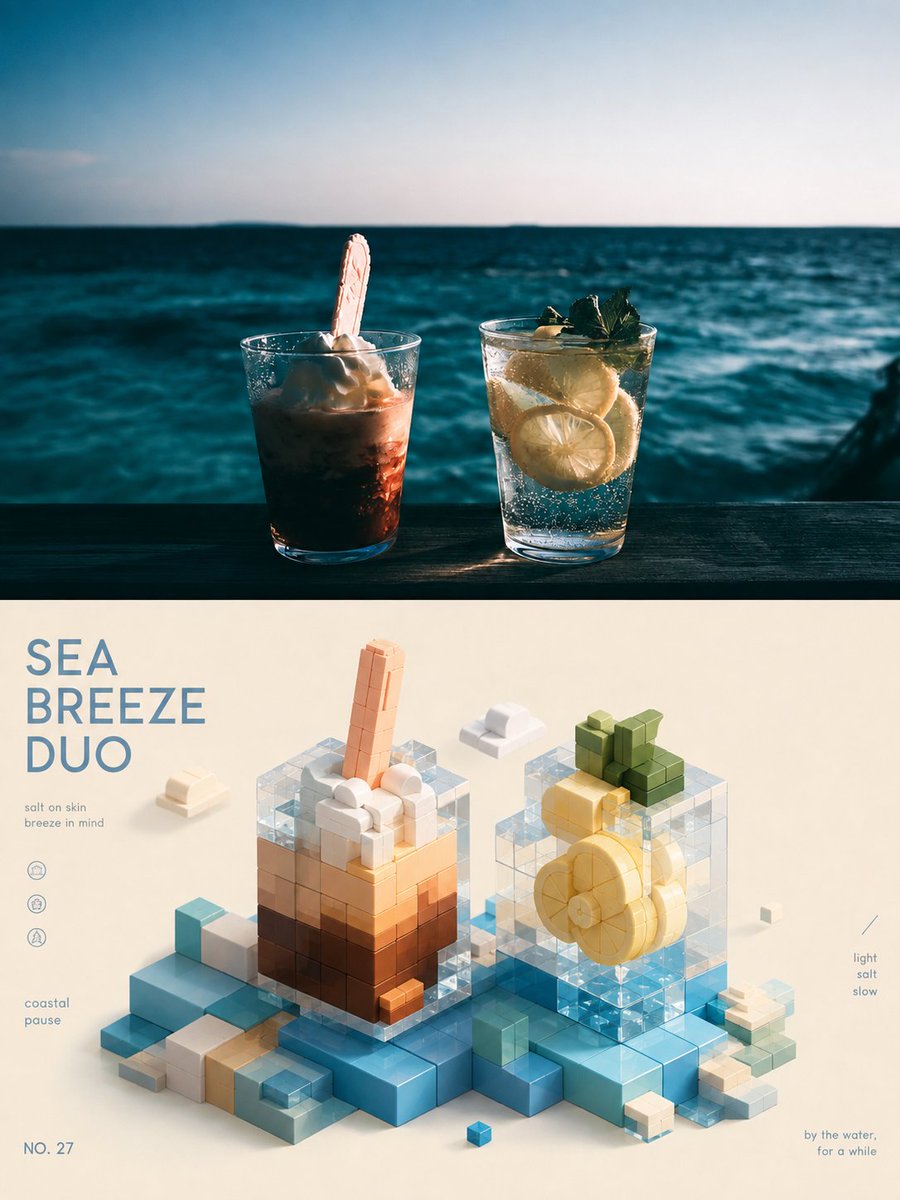
Please turn each photo I upload into an independent high-end design poster. Do not stitch multiple images together; each photo should be output separately. The overall layout uses a 3:4 vertical composition, with the top and bottom areas strictly 1:1, each occupying 50% of the frame.

The top half retains the original photo, keeping the subject's structure, spatial relationships, real materials, natural lighting, and original color atmosphere, with only minor high-end photographic color grading to give it the texture of an art magazine, independent publication, or exhibition photography. To fit the aspect ratio, the environment/background can be naturally extended, but the subject must not be stretched, distorted, or changed.

The bottom half extracts the most recognizable **subject, silhouette, posture, and narrative relationship** from the photo. Following the logic of "deconstruction—screening—refinement—reconstruction," it is transformed into a **3D / isometric spatial {argument name="style" default="healing-style block sculpture"}**. Focus on preserving the most unique volume proportions, axes, curves, intersections, layering, occlusions, and negative spaces of the subject, reorganized with rounded, simple, and tactile modular blocks; do not perfectly replicate details, but the correspondence with the original image above must be immediately felt.

The composition is adaptively designed based on the subject's own visual center of gravity, posture direction, and spatial relationships. Rhythm is established through blocks of varying sizes, staggered heights, front-to-back intersections, partial suspension, density changes, and large areas of white space. Blocks can be spliced, stacked, nested, crossed, or naturally misplaced, allowing the subject to retain its identity while possessing a contemporary art toy-like sculptural feel and relaxed imagination, avoiding mechanical disassembly and simple pixelation.

**The color scheme must be analyzed and generated from the original image above.** First, identify the most vibrant and recognizable main color relationships, along with comprehensive color temperature, brightness levels, cold-warm echoes, and key accent colors. Then, re-modulate these colors into a softer, clearer, brighter, and more airy healing color system. Preserve the hue identity and emotional memory of the original image, but moderately increase brightness, reduce harsh contrast, and purify muddy colors to make the colors feel gentle, childlike, light, and high-end. Different photos should naturally yield different color schemes; do not use any fixed preset color cards, and do not forcibly add colors that do not exist in the original image just for a "healing feel."

Color establishes rhythm through **main color area, secondary color layers, homologous shades, and a tiny amount of vivid accent colors**, making the subject look rich but not cluttered, cute but not too sweet, soft but energetic. The block material uses a fine matte, soft diffuse reflection texture, with a feel like slight pulp, wood, pastel, or flexible materials, with rounded corners and soft shadows, avoiding plastic highlights, metallic feel, heavy CG, and cheap toy textures.

Text establishes a light, high-end editorial micro-typography system. Extract a {argument name="length" default="2-5 word"} title from the photo's light and shadow, action, space, emotion, or symbolic meaning, and pair it with a few state words, locations, numbers, directional words, or miniature notes. Do not use years. Text can be arranged along block edges, module gaps, visual axes, or negative spaces, or it can intersect, be occluded by, or align with the blocks, making the text naturally part of the block composition.

The overall presentation features a visual temperament of **Real Photography × {argument name="core element" default="Healing Blocks"} × Isometric Space × Original Color Translation × High-end Editorial Design**, which is gentle, light, childlike, quiet, exquisite, and imaginative but not naive.
Original prompt
请将我上传的每一张照片分别制作成一张独立的高级设计海报,不多图拼接,每张照片单独输出。整体采用3:4竖版构图,上下两个区域高度严格1:1,各占画面50%。

上半部分保留原始照片,保持主体结构、空间关系、真实材质、自然光影和原有色彩氛围,仅进行轻微高级摄影调色,使其具有艺术杂志、独立出版物与展览摄影质感。为适配画幅,可自然扩展环境背景,但不得拉伸、扭曲或改变主体。

下半部分提取照片中最具识别性的**主体、轮廓、姿态与叙事关系**,按照“解构—筛选—提炼—重构”的逻辑,转化为具有 **3D / isometric 空间感的{argument name="风格" default="治愈系积木雕塑"}**。重点保留主体最独特的体量比例、轴线、曲线、穿插、层叠、遮挡与负空间,以圆润、简洁、具有触感的模块化体块重新组织;不完整复刻细节,但必须一眼感受到与上方原图的对应。

构图根据主体自身的视觉重心、姿态方向和空间关系自适应设计,通过大小体块、高低错层、前后穿插、局部悬浮、疏密变化与大面积留白建立节奏。积木可以拼接、叠放、嵌套、穿越或自然错位,使主体既保留身份,又具有当代艺术玩具般的雕塑感和轻松想象力,避免机械拆件和简单像素化。

**配色必须从上方原图本身分析产生。** 先识别照片中最有生命力、最有辨识度的主色关系,以及综合色温、明度层级、冷暖呼应和关键点色,再将这些颜色重新调制为更柔和、清澈、明亮、有空气感的治愈色彩体系。保留原图的色相身份与情绪记忆,但适度提高明度、降低刺眼对比、净化灰脏杂色,使颜色呈现温柔、童趣、轻盈而高级的感觉。不同照片应自然得到不同配色,不固定使用任何预设色卡,也不要为了“治愈感”强行加入原图不存在的颜色。

色彩通过**主色面积、辅助色层次、同源深浅与极少量鲜活点色**建立节奏,让主体看起来丰富但不杂乱、可爱但不甜腻、柔和但有精气神。积木材质采用细腻哑光、柔和漫反射的质感,带轻微纸浆、木质、粉蜡或柔性材料般的触感,边角圆润、阴影轻柔,避免塑料高光、金属感、厚重CG和廉价玩具质感。

文字建立轻盈的高级编辑式微排版系统,从照片的光影、动作、空间、情绪或象征意义中提炼一个{argument name="字数" default="2–5词"}的标题,并搭配少量状态词、地点、编号、方向词或微型注释,不使用年份。文字可沿积木边缘、模块缝隙、视觉轴线或负空间排列,也可与体块形成穿插、遮挡与对齐,让文字自然成为积木构图的一部分。

整体呈现 **真实摄影 × {argument name="核心元素" default="治愈积木"} × isometric空间 × 原图色彩转译 × 高级编辑设计** 的视觉气质,温柔、轻盈、童趣、安静、精致、有想象力但不幼稚。
Use this prompt in the VdoBloom image editor.
Opens the image editor with this prompt — add your own photo to generate.