Fictional Science Infographic Generator
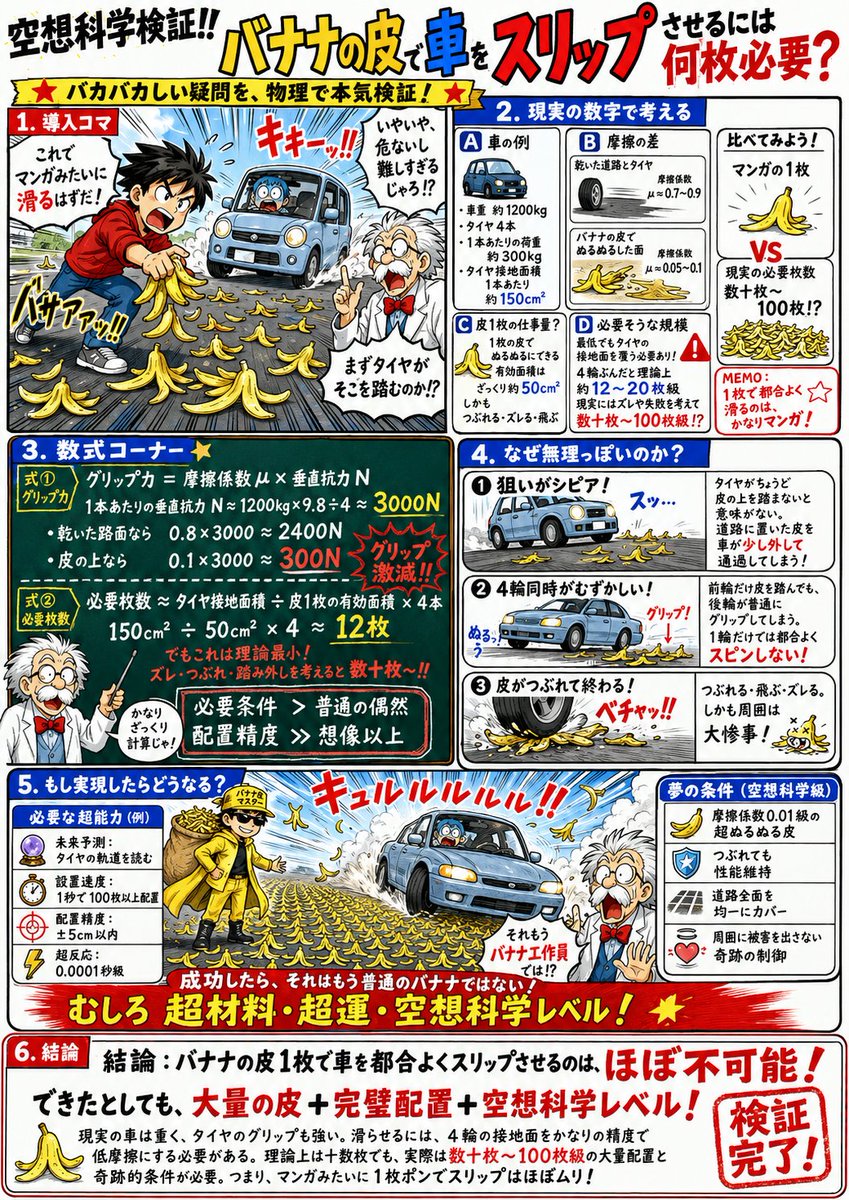
Full prompt
Create a comical scientific explanation illustration. The verification theme is "{argument name="validation theme" default="How many banana peels are needed to make a car slip?"}"

A vertical A4 manga-style infographic that seriously verifies absurd questions with science and calculations. White background, thick black lines, and emphasis colors of red, blue, and yellow. A design reminiscent of retro educational manga, science reference books, or scientific columns. Use a professor character, surprised people, speech bubbles, hand-drawn arrows, red pen annotations, and chalkboard-style formula boxes. The overall atmosphere should be 'using physics to verify a silly question with full effort,' making it fun, energetic, and not too serious.

Structure:

1.
Depict the theme's situation in an exaggerated and ridiculous way that is understood at a glance. The characters are trying their best, but the appearance is quite reckless. The professor interjects with a comment from the side.

2. Thinking with Real Numbers
Display 3 to 4 boxes of important values related to the theme, such as speed, time, distance, weight, force, temperature, or energy. Include comparison charts or timelines to clearly show the gap between 'human senses' and the 'scale of the phenomenon.'

3. Formula Corner
Draw necessary conditions or comparison formulas largely in chalkboard-style frames. Example: 'Required Ability > Human Limit' 'Reaction Time < Time Phenomenon Occurs' 'Required Force/Speed/Durability ≫ Normal Human.' Formulas don't need to be strictly accurate; keep them intuitive and easy to understand.

4. Is Realization Impossible?
Explain problem points using three small panels. Example: ① Too fast / Too heavy / Too hot ② Precision is too severe ③ Even if successful, the body won't hold out / Surroundings will be in trouble. Include comical failure illustrations, onomatopoeia, and speech bubbles.

5. What If It Was Realized?
Make this part important. Illustrate what superhuman or speculative scientific abilities would be needed to actually succeed. For example, super reflexes, future prediction, abnormal grip strength, ultra-high-speed vision, physical ability to ignore air resistance, or a skeleton that can withstand impact. If necessary, use scientifically impossible numbers like 'reaction speed 0.0001s,' 'grip strength 3000kg,' or 'dynamic vision dozens of times that of a fighter pilot.' Furthermore, depict what happens the moment it is realized. Example: an impact that blows an arm off, sinking into the ground, shockwaves in the surroundings, while the person themselves remains calm. Bring out the 'if successful, they are no longer human' feeling in a fun way.

6. Conclusion
Write the conclusion largely in a red highlighted frame. 'Conclusion: XX is almost impossible for a normal human!' or 'Even if realized, it would be at a superhuman, cyborg, or speculative science level!' Summarize it in a way that states it's impossible for real humans but achievable with speculative scientific abilities.

Design Specifications: Manga paneling + science illustrations + professor's commentary. Use thick headings, red circles, emphasis lines, hand-drawn notes, and speech bubbles frequently. Formulas and numerical values should be large and easy to read, conveying the message intuitively even to children. Finish it like a page from an interesting science reading that is absurd yet strangely convincing.
Original prompt
コミカルな科学解説イラストを作成。 検証テーマは「{argument name="検証テーマ" default="バナナの皮で車をスリップさせるには何枚必要?"}」

バカバカしい疑問を、大真面目に科学と計算で検証する、縦長A4の漫画風インフォグラフィック。 白背景、太い黒線、赤・青・黄色の強調色。少しレトロな学習漫画、理科参考書、科学コラム風のデザイン。 博士キャラ、驚く人物、吹き出し、手描き矢印、赤ペン注釈、黒板風の数式枠を使う。 全体は「くだらない疑問を物理で全力検証する」雰囲気で、深刻すぎず、楽しく、勢いのある紙面にする。

構成:

1.
テーマの状況を大げさでバカバカしく、ひと目で伝わるように描く。 登場人物は本気で挑戦しているが、見た目はかなり無茶。 博士が横からツッコミを入れる。

2. 現実の数字で考える
速度・時間・距離・重さ・力・温度・エネルギーなど、テーマに関係する重要な数値を3〜4個のボックスで表示。 比較図やタイムラインを入れて、「人間の感覚」と「現象のスケール」のズレを分かりやすく見せる。

3. 数式コーナー
黒板風の枠に、必要条件や比較式を大きく描く。 例: 「必要能力 > 人間の限界」 「反応時間 < 現象が起こる時間」 「必要な力・速度・耐久力 ≫ 普通の人間」 数式は厳密すぎなくてよく、直感的でわかりやすくする。

4. 実現は無理?
問題点を3つの小コマで説明。 例: ① 速すぎる / 重すぎる / 熱すぎる ② 精度がシビアすぎる ③ 成功しても身体がもたない / 周囲が大変なことになる コミカルな失敗イラスト、擬音、吹き出しを入れる。

5. もし実現したらどうなる?
ここを重要にする。 もし本当に成功させるなら、どんな超人的・空想科学的能力が必要かを図解する。 たとえば、超反射神経、未来予測、異常な握力、超高速視覚、空気抵抗を無視する身体能力、衝撃に耐える骨格など。 必要なら「反応速度0.0001秒」「握力3000kg」「動体視力が戦闘機パイロットの数十倍」など、科学的に実現不可能な数字でもOK。 さらに、実現した瞬間に何が起きるかも描く。 例:腕が吹き飛ぶほどの衝撃、地面にめり込む、周囲に衝撃波、本人だけ平然としている、など。 “成功したらそれはもう人間ではない”感じを面白く出す。

6. 結論
赤い強調枠で大きく結論を書く。 「結論:〇〇は普通の人間にはほぼ不可能!」 または 「実現できたとしても、それは超人・改造人間・空想科学レベル!」 本文では、現実の人間では無理だが、空想科学的な能力を与えれば成立する、という形でまとめる。

デザイン指定: 漫画のコマ割り+理科の図解+博士の解説。 太い見出し、赤丸、強調線、手描きメモ、吹き出しを多用。 数式や数値は大きく見やすく、子どもにも直感的に伝わるようにする。 全体として、バカバカしいのに妙に納得感がある、おもしろ科学読み物の1ページのように仕上げる。
Use this prompt in the VdoBloom image editor.
Opens the image editor with this prompt — add your own photo to generate.