Book of Kells Restoration Comparison
Full prompt
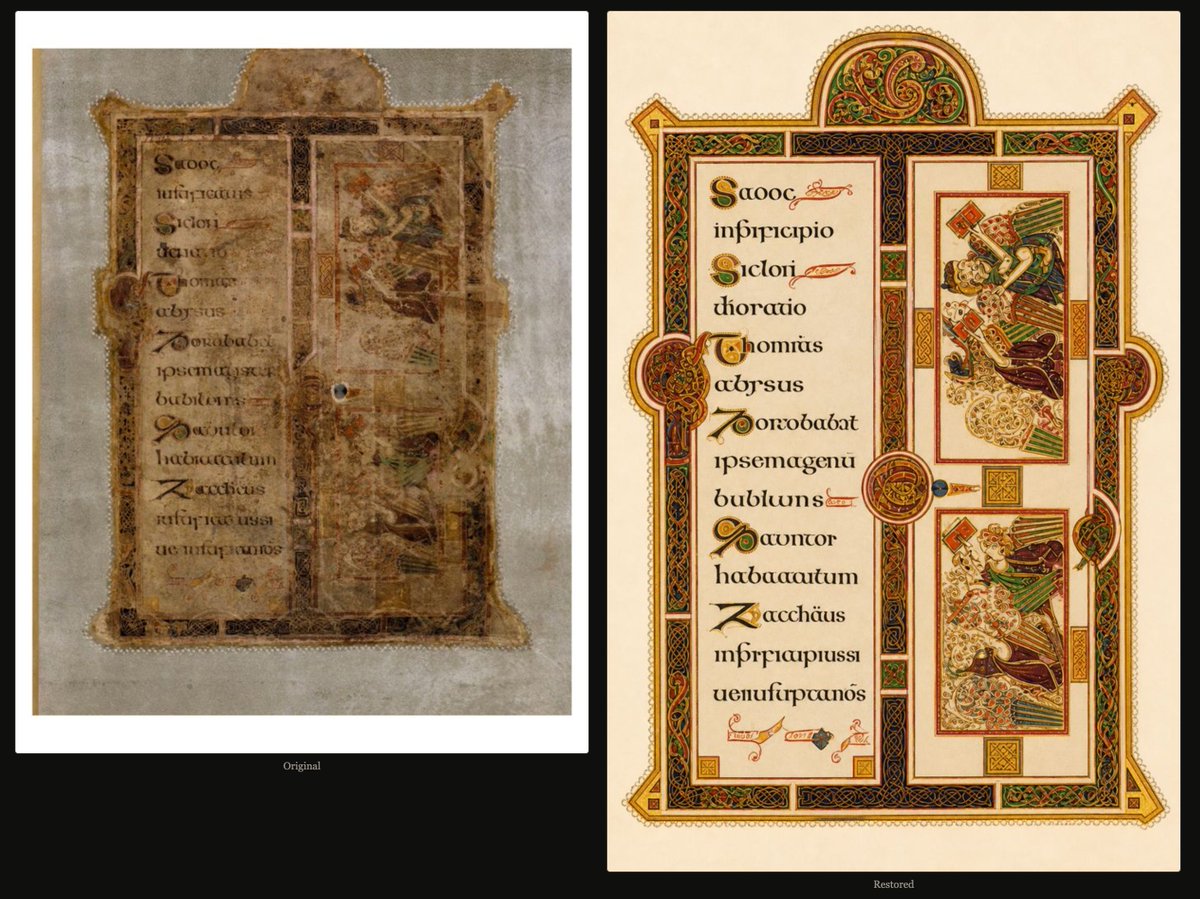
Goal: Create a side-by-side comparison image showing an ancient illuminated manuscript page before and after restoration, inspired by the Book of Kells, with the restored version looking far cleaner, brighter, and more ornate than the damaged original.

Canvas: Wide horizontal black background, approximately 16:9. Place two large vertical manuscript panels side by side with generous margins: the left panel is the damaged original, the right panel is the restored reconstruction. Add a small centered label under each panel: left label “Original”, right label “Restored”.

Layout: Use exactly 2 main panels. The left panel occupies the left half and sits inside a white photo-like border. The right panel occupies the right half and is larger-looking, crisp, and framed by a pale parchment page edge. Both panels show the same general manuscript-page composition: a tall decorative border, a left text column, and a right illustration column.

Left panel, damaged original: Show a faded, weathered manuscript page photographed on a grayish archival background. The parchment is brown, stained, frayed, and translucent in places, with torn edges, missing corners, water damage, darkened seams, and uneven discoloration. The design is barely legible: a vertical text block on the left with dark medieval calligraphy, faded red and gold initials, and a right column with two ghostly miniature illustrations that are almost erased. The ornamental border should be visible but worn, dirty, and incomplete. Include one small dark circular blemish or hole near the center-right of the original page. Keep the whole left image muted, low contrast, and degraded.

Right panel, restored version: Show a vividly restored illuminated manuscript page on warm cream parchment. The page has a highly polished medieval Celtic style with abundant gold leaf, red, green, black, and orange ornament. Use an ornate architectural frame with interlacing knotwork, geometric panels, round medallions, and a domed arch at the top. The restoration should look idealized and too pristine, with sharp lines and saturated colors.

Restored page element count: Include exactly 1 large outer decorated manuscript frame; exactly 1 domed arch at the top filled with Celtic spiral ornament; exactly 4 protruding side ornaments on the frame, one at each side midpoint and corner-like extension; exactly 1 left vertical text column containing 10 lines of pseudo-Latin uncial calligraphy with decorated initials; exactly 2 rectangular narrative miniature illustrations stacked vertically in the right column; exactly 3 circular medallion ornaments overlapping the central divider and side frame; exactly 4 small square gold decorative blocks, placed near the top, center, lower center, and bottom of the frame.

Text and lettering: The manuscript text should resemble medieval Insular script and pseudo-Latin, not modern readable typography. Use decorative initials in green, red, gold, and black. Suggested visible pseudo-text can include “Scooc”, “infiricipio”, “Sicloi”, “thoratio”, “chomias”, “abysus”, “Zorozobat”, “ipsemagenu”, “bubliuns”, “Qauncor”, “habacautum”, “Zacchäus”, and “uenufurcanos”, but it may remain partly nonsensical as long as the style matches.

Visual style: Museum-comparison presentation, archival documentary on the left and idealized digital restoration on the right. High contrast between decay and restoration. The restored page should include obvious metallic gold leaf highlights, clean parchment, Celtic knots, evangelist-manuscript styling, and intricate medieval ornament.

Constraints: Do not add extra panels, people, UI controls, watermarks, or explanatory captions beyond the two small labels. Keep the comparison balanced and centered on a plain black background.
Use this prompt in the VdoBloom image editor.
Opens the image editor with this prompt — add your own photo to generate.