Chinese Aesthetic Window Scenery Poster
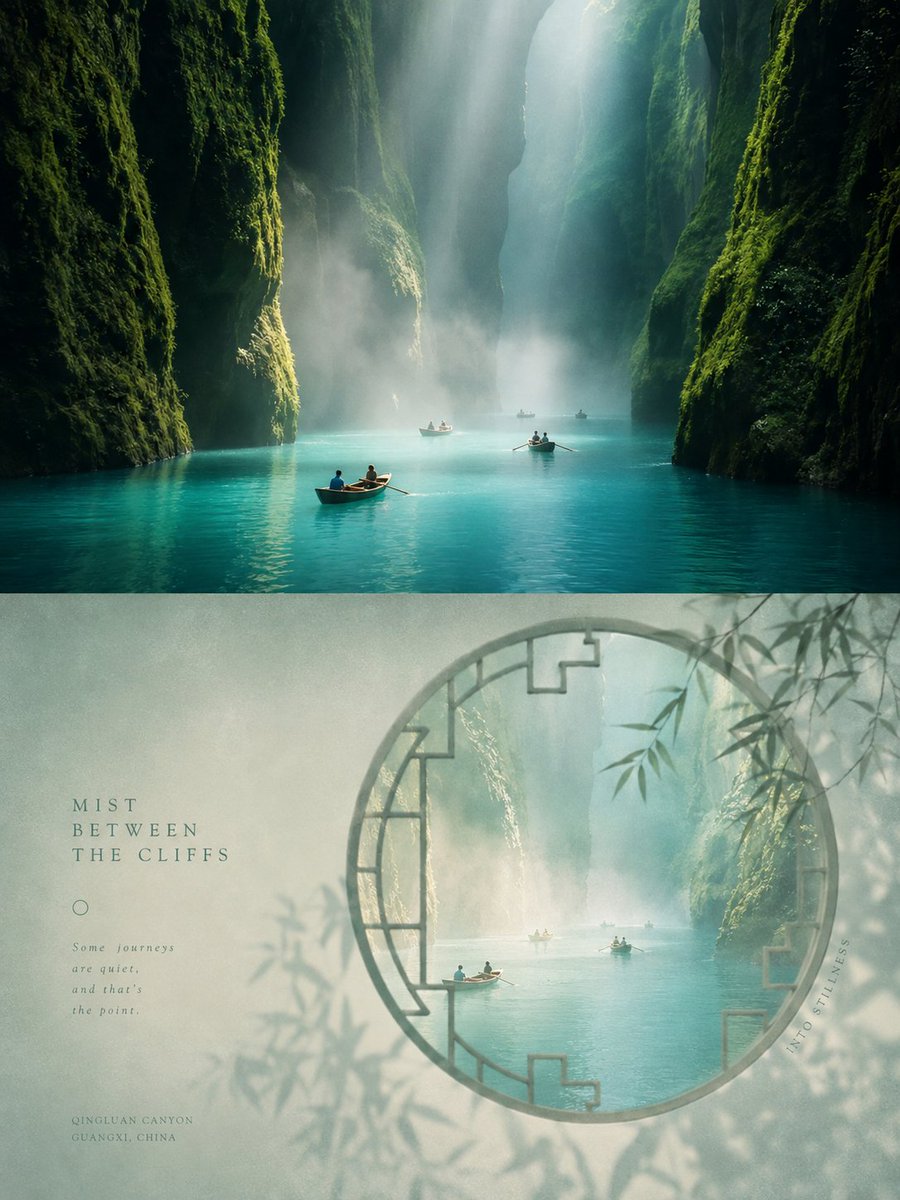
Full prompt
Please transform each photo I upload into an independent, high-end design poster, outputting each photo separately without stitching multiple images. The overall layout adopts a {argument name="poster ratio" default="3:4 vertical composition"}, with the top and bottom sections strictly at a 1:1 height ratio, each occupying 50% of the screen.

The upper half retains the original photo, maintaining the main structure, real texture, natural light and shadow, and the original color atmosphere, with only slight professional color grading to give it the feel of an art magazine, independent publication, or exhibition photography. To fit the frame, the sky, ground, or environmental background can be naturally extended, but the subject must not be stretched, distorted, or altered.

The lower half extracts the most recognizable subject, silhouette, posture, and narrative relationship from the photo, reconstructing it into a soft, misty atmospheric illustration with an oriental framing order. Use traditional Chinese architectural elements like round windows, latticed windows, moon gates, fan-shaped windows, hexagonal windows, or geometric window frames as the main structural framework, choosing the most suitable type based on the subject's form. Subjects, branch shadows, light spots, or abstract projections appear, pass through, block, or spill over within the window shape, so the frame fixes the order while creating spatial layers between void and solid.

The composition emphasizes visual focus, proportional relationships, positive/negative space, and the rhythm of white space. The window shape doesn't need to be perfectly centered; it can be slightly offset, partially cropped, or suspended on one side. The subject and light/shadow form a primary-secondary relationship around the window, establishing a stable yet poetic visual triangle through one main light area, a quiet white space, and a few soft projections. Avoid even filling, excessive symmetry, and complex decorations to keep the screen simple yet orderly with a sense of breathability.

The background is not fixed as dark blue; instead, extract a {argument name="background color" default="very light, low-saturation, clean composite color coordinated with the original image"} such as misty blue, light cyan, pale apricot, soft pink, grayish green, warm off-white, or very light purple-gray, creating a gentle and clear brightness contrast between the background and the subject. Light and shadow are refined from the most vibrant colors in the original image, moderately brightened or purified to form a soft warm-cold echo. Avoid dirty grays, heavy dark backgrounds, fluorescent colors, and harsh high contrast.

The texture uses fine inkjet particles, pastels, airy soft focus, and diffused light, with naturally blurred edges and slight grain, dust, and color bleeding. The window frames can be slightly sharper than the light and shadow but remain soft without hard architectural outlining; let the image look like sunlight projecting through traditional window frames onto a light-colored wall, gently blurred by memory and air.

Text intervenes as a small order in the composition, extracting a {argument name="English title" default="very short English title"} from the photo's emotion, time, action, temperature, or metaphor, paired with a few location words, status words, or tiny phrases. Text can be arranged along window edges, curves, axes, or light-and-shadow white space, forming alignment, surrounding, staggered, or interspersed relationships with the window shape, using very small font sizes, light weights, and wide letter spacing for a quiet, high-end editorial feel.

The overall presentation is an oriental modern visual composed of a light breathable background, traditional window framing, soft colored light and shadow, inkjet particles, void-solid projections, and large areas of white space. Whether the subject is a person, animal, plant, architecture, object, or natural landscape, it should maintain a clear echo with the upper photo while possessing a gentle, quiet, clear, poetic, healing, and high-end artistic temperament, avoiding cartoonishness, cheap filters, heavy dark colors, cluttered decorations, and template-like feels.
Original prompt
请将我上传的每一张照片分别制作成一张独立的高级设计海报,不多图拼接,每张照片单独输出。整体采用{argument name="海报比例" default="3:4竖版构图"},上下两个区域高度严格1:1,各占画面50%。

上半部分保留原始照片,保持主体结构、真实质感、自然光影和原有色彩氛围,仅进行轻微高级摄影调色,使其具有艺术杂志、独立出版物和展览摄影质感。为适配画幅,可自然扩展天空、地面或环境背景,但不得拉伸、扭曲或改变主体。

下半部分提取照片中最具识别性的主体、轮廓、姿态与叙事关系,重构为一张柔和、朦胧而具有东方框景秩序的氛围插画。以中国传统建筑中的圆窗、花窗、漏窗、月洞、扇形窗、六角窗或几何棂格作为主要结构框架,根据主体形态选择最合适的一种,不机械套用。主体、枝影、光斑或抽象投影在窗形中显现、穿过、遮挡或溢出,使窗框既固定画面秩序,又形成虚实之间的空间层次。

构图强调视觉重心、比例关系、正负形与留白节奏。窗形不必绝对居中,可轻微偏置、局部裁切或悬置于画面一侧;主体与光影围绕窗形形成主次关系,通过一处主要光区、一处安静留白和少量柔和投影建立稳定而富有诗意的视觉三角。避免平均铺满、过度对称和复杂装饰,让画面看似简单,却具有明确的空间秩序与呼吸感。

背景不固定使用深蓝,而从上方照片中提取一个{argument name="背景色" default="非常浅、低饱和、干净且与原图协调的综合色"},如雾蓝、浅青、淡杏、柔粉、灰绿、暖米白或极浅紫灰,使背景与主体之间产生温柔而清晰的明度落差。光影则从原图最有生命力的颜色中提炼,可适度提亮、提纯,形成柔和的冷暖呼应。整体避免脏灰、厚重暗底、荧光色和生硬高反差。

质感采用细腻的喷绘颗粒、色粉、空气感柔焦与漫射光,光影边缘自然虚化,带轻微颗粒、粉尘和色彩晕染。窗格本身可以比光影稍清晰,但仍保持柔和,不做硬质建筑描边;让画面像阳光透过传统窗棂投射在一面浅色墙上,被记忆和空气轻轻模糊。

文字作为构图中的微小秩序介入,从照片的情绪、时间、动作、温度或隐喻中提炼一个{argument name="英文标题" default="极短英文标题"},并搭配少量地点词、状态词或微型短句。文字可沿窗框边缘、弧线、轴线或光影留白排布,与窗形形成对齐、环绕、错位或穿插关系,以极小字号、细字重和宽字距形成安静的高级编辑感。

整体呈现浅色呼吸感背景、传统窗形框景、柔和有色光影、喷绘颗粒、虚实投影与大面积留白共同构成的东方现代视觉。无论主体是人物、动物、植物、建筑、器物或自然景观,都应保持与上方照片清晰呼应,同时具有温柔、静谧、清透、诗意、治愈而高级的艺术气质,避免卡通感、廉价滤镜、厚重暗色、杂乱装饰和模板感。
Use this prompt in the VdoBloom image editor.
Opens the image editor with this prompt — add your own photo to generate.