Da Vinci Isometric Structural Poster
Full prompt
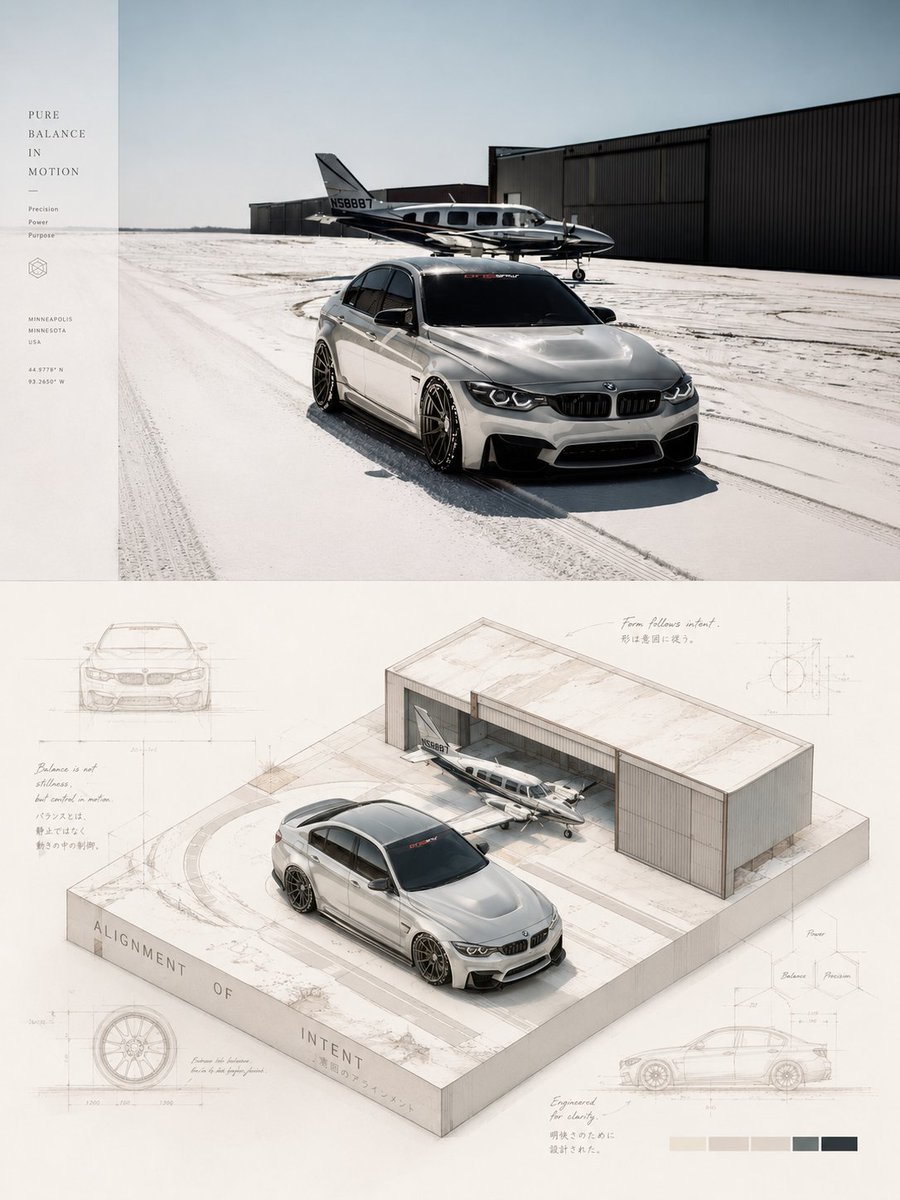
Please turn each photo I upload into an individual high-end design poster, no multi-image stitching, each photo output separately. The overall composition adopts a 3:4 portrait format, with the top and bottom areas strictly 1:1 in height, each occupying 50% of the frame.

The upper part retains the original photo, maintaining the main structure, real texture, natural light/shadow, and original color atmosphere, with only slight professional photographic color grading to give it an art magazine, independent publication, or exhibition photography feel. To fit the aspect ratio, the sky, ground, or environmental background can be naturally extended, but the subject must not be stretched, distorted, or changed.

The lower part extracts the most recognizable **subject, silhouette, posture, and narrative relationship** from the photo, reconstructed with **isometric spatial logic**. It is not simply turning the original object into a 3D model, but dismantling the subject into clear blocks, levels, sections, and spatial relationships, recombining them in a unified isometric axis to have both the structural order of an architectural model and the visual generalization of an editorial illustration. The viewing angle, scale, and local structure can be moderately adjusted to better showcase the most representative form of the subject, but it must remain instantly recognizable.

Simultaneously, extract a **thematic image** from the core content, action, structure, or symbolic relationship of the photo, geometrizing and symbolizing it to integrate into the isometric composition. The thematic image can serve as a base, a section, a spatial gap, a path, an enclosing structure, or a negative shape, allowing the subject to interact through penetration, fitting, suspension, cutting, support, or staggered layering. The theme is not an additional decoration but a compositional mechanism that determines how the subject exists in space.

The composition is adaptively designed based on the visual center of gravity, silhouette trend, and spatial characteristics of the subject, establishing a professional order through isometric axes, block proportions, hierarchical staggering, scale contrast, local cropping, and large areas of negative space. The subject does not need to be mechanically centered; it can be offset, suspended, or extended, so that the isometric structure and thematic image together form the sole visual center.

The subject uses **high-brightness, clear, and soft Japanese-style color palettes with delicate matte materials**. Colors are extracted and modulated from the most vibrant and representative spirits of the subject in the photo above, using soft white, cream white, or very light warm tones as the base, converting core colors into clean, bright, soft planes, distinguishing different blocks through tonal variations and minimal accent colors. Lighting is soft yet clear, using slight light and shadow to help read the structure, avoiding heavy 3D shadows, plastic materials, and muddy tones.

The background maintains a large amount of white space and incorporates **Leonardo da Vinci-style creative research marks**: silhouette sketches related to the subject, structural dismantling, partial enlargements, proportion lines, measurement lines, arrows, geometric deductions, natural observation line drawings, and micro-annotations, faintly distributed around the subject in pale pencil, ochre ink, or faded manuscript texture. The manuscript should be like thought tracks left by the design process, contrasting the precise isometric subject as 'rational product vs. emotional research process,' without forming a second visual center.

Text is also organized around the theme and spatial structure. Extract a short English title from the subject's identity, action, emotion, or symbolic meaning of the photo, paired with a minimal amount of location, status words, or micro-annotations. Text can be arranged along isometric axes, thematic image boundaries, structural sections, or manuscript auxiliary lines, in horizontal, vertical, staggered, interspersed, or hidden in negative shapes, making the text look like an information layer in design drawings and high-end art publications rather than an afterthought title.

The overall presentation features a visual temperament of **Thematic Metaphor × Isometric Spatial Order × Da Vinci-style Research Manuscript × Japanese Clear Colors × Eastern Negative Space × High-end Editorial Design**. Whether the subject is a person, animal, plant, building, object, food, vehicle, or natural landscape, it should find the most suitable isometric reconstruction method based on its own structure, avoiding ordinary 3D models, game scene vibes, axonometric engineering drawing vibes, cartoon low-poly, mechanical centering, e-commerce display vibes, and template-like feel.
Original prompt
请将我上传的每一张照片分别制作成一张独立的高级设计海报,不多图拼接,每张照片单独输出。整体采用3:4竖版构图,上下两个区域高度严格1:1,各占画面50%。

上半部分保留原始照片,保持主体结构、真实质感、自然光影和原有色彩氛围,仅进行轻微高级摄影调色,使其具有艺术杂志、独立出版物和展览摄影质感。为适配画幅,可自然扩展天空、地面或环境背景,但不得拉伸、扭曲或改变主体。

下半部分提取照片中最具识别性的**主体、轮廓、姿态与叙事关系**,以 **isometric 等距空间逻辑重新构建**。不是把原物简单变成3D模型,而是将主体拆解为清晰的体块、层级、切面与空间关系,在统一等距轴线中重新组合,使其兼具建筑模型般的结构秩序与编辑插画般的视觉概括。可适度调整观察角度、比例和局部结构,以更好地展示主体最有代表性的形态,但必须保持一眼可识别的身份特征。

同时从照片的核心内容、动作、结构或象征关系中提炼一个**主题意象**,将其几何化、符号化并融入isometric构图。主题意象可以成为底座、切面、空间缺口、路径、包围结构或负形,让主体与其发生穿越、嵌合、悬浮、切割、承托或错层关系,使主题不是附加装饰,而是决定主体如何存在于空间中的构图机制。

构图根据主体的视觉重心、轮廓走势 and 空间特性自适应设计,通过等距轴线、体块比例、层级错落、尺度反差、局部裁切和大面积留白建立专业秩序。主体不必机械居中,可偏置、悬浮或延伸,让isometric结构与主题意象共同形成唯一视觉中心。

主体采用**高明度、清透、柔和的日系配色与细腻哑光材质**。颜色从上方照片中提取最有生命力、最能代表主体精气神的色彩重新调制,以柔白、奶油白或极浅暖色作为基础,将核心色转化为干净、明亮、轻柔的色面,通过同色深浅和少量点色区分不同体块。光影柔和而明确,用轻微明暗帮助读取结构,避免厚重3D阴影、塑料材质和灰脏色调。

背景保持大量留白,并加入**达·芬奇手稿式的创作研究痕迹**:与主体相关的轮廓草图、结构拆解、局部放大、比例线、测量线、箭头、几何推演、自然观察线稿和微型注释,以极淡的铅笔、赭色墨线或褪色手稿质感若隐若现地分布在主体周围。手稿应像设计过程留下的思考轨迹,与精确的isometric主体形成“理性成品与感性研究过程”的对照,不形成第二视觉中心。

文字同样围绕主题和空间结构组织。从照片的主体身份、动作、情绪或象征意义中提炼一个简短英文标题,并搭配极少量地点、状态词或微型注释。文字可以沿isometric轴线、主题意象边界、结构切面或手稿辅助线排列,横排、竖排、错位、穿插或隐藏于负形中,使文字像设计图纸和高级艺术出版物中的信息层,而不是后期贴上的标题。

整体呈现**主题隐喻 × Isometric空间秩序 × 达·芬奇式研究手稿 × 日系清透色彩 × 东方留白 × 高级编辑设计**的视觉气质。无论主体是人物、动物、植物、建筑、器物、食物、交通工具或自然景观,都应以其自身结构找到最合适的等距重构方式,避免普通3D模型、游戏场景感、轴测工程图感、卡通低多边形、机械居中、电商展示感和模板感。
Use this prompt in the VdoBloom image editor.
Opens the image editor with this prompt — add your own photo to generate.