Handcrafted String Visualization Map
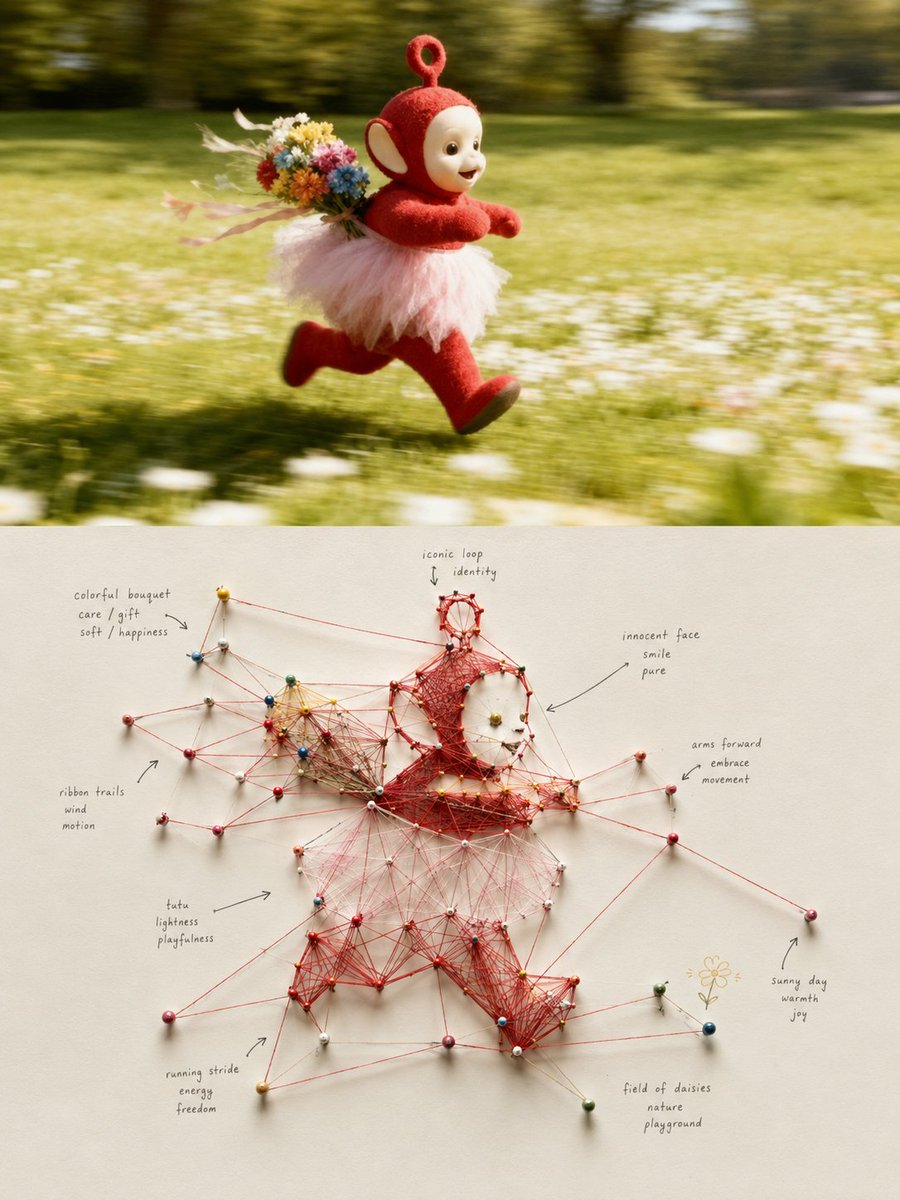
Full prompt
☺️🥸🤠
Please make each photo I upload into an independent high-end design poster, no multi-image stitching, each photo output separately. Overall, use a {argument name="ratio" default="3:4 vertical"} composition, the top and bottom areas are strictly 1:1, each occupying 50% of the frame.

The top half retains the original photo, maintaining the subject's identity, structure, posture, real texture, natural light and shadow, and original color atmosphere, with only slight high-end color grading to give it the texture of an art magazine, independent publication, or exhibition image. To fit the frame, the environmental background can be naturally extended, but the subject must not be stretched, distorted, or changed.

The bottom half extracts the most recognizable **subject, outline, structure, posture, and narrative relationship** of the photo, translating it into a real, touchable **{argument name="style" default="Physical String-based Systems Map / Tangible Node-link Visualization"}**. Do not depict the original object directly, but disassemble the subject into a small number of meaningful nodes and relationships: key outlines, structural turns, movement directions, spatial positions, or environmental clues become pushpin-style Nodes, and real strings are used as Edges / Links between them, so that the visual relationships of the original photo manifest again in a physical network, and the identity and structure of the original subject can still be vaguely recognized.

The composition uses a clear **core node or core relationship** as the visual pivot, and the other nodes naturally unfold around the subject's structure. The strings are not randomly wound but should establish relationships according to the direction, proportion, distance, connection, and narrative logic of the original image; some nodes form radial, convergent, triangular, polygonal, and cross-regional connections, causing a large number of simple relationships to naturally produce **emergent geometry**. The whole is complex yet orderly, with denser central relationships and gradually sparser outer areas, retaining plenty of negative space to avoid filling the entire layout.

The material must have a real physical installation feel: use small pushpins, stitches, cotton thread or twine, paper labels, handwritten marks, and a real cardboard surface, retaining slight string tension differences, node heights, cross-shading, stitch shadows, and manual errors. The whole is like an art-directed research wall, system design experiment, or information art installation, not a computer-drawn network diagram, nor cyber UI, digital glowing lines, or cheap detective board effects.

The string uses a **sharp but restrained {argument name="line color" default="vermilion, coral red, or warm red"}** as the primary relationship color, creating visual tension against a large number of natural white, warm white, light grey, or very light backgrounds coordinated with the color temperature of the photo above; pushpins, paper tags, and a few markers can extract local characteristic colors from the photo above for low-area echo. The overall color is clean, modern, and vibrant, avoiding dark brown, dirty old, bloody red horror feel, and excessive retro aging.

Text intervenes freely as **Hand-lettered Annotation** in the system, without presetting fixed titles, locations, years, or menu-style information. Based on the subject, action, position, emotion, relationship, or metaphor in the photo, freely generate a few keywords, short sentences, arrows, circled notes, or tiny explanations, and write them directly near nodes, at string intersections, or in blank areas. The font uses a **small, relaxed, slightly research-note-like handwritten annotation font with writing deviations**, making the text look like thoughts naturally left during the observation process, while maintaining the restraint and readability of high-end editorial design.

The overall presentation is a high-end experimental visual composed of **physical nodes, red strings, relationship mapping, emergent geometry, handwritten annotations, and plenty of white space**. Whether the subject is a person, animal, plant, building, object, vehicle, natural landscape, or complex scene, it should translate "what it is" further into "how its parts relate," forming a physical information visualization with research feel, artistic feel, systematicity, and manual warmth. Avoid random red lines, meaningless nodes, full-page chaos, horror crime boards, digital network UI, cartoon pushpins, templated mind maps, and ordinary flowcharts.

😌🥲😘
Original prompt
☺️🥸🤠
请将我上传的每一张照片分别制作成一张独立的高级设计海报,不多图拼接,每张照片单独输出。整体采用{argument name="比例" default="3:4竖版"}构图,上下两个区域高度严格1:1,各占画面50%。

上半部分保留原始照片,保持主体身份、结构、姿态、真实质感、自然光影 and 原有色彩氛围,仅进行轻微高级调色,使其具有艺术杂志、独立出版物与展览图像质感。为适配画幅,可自然扩展环境背景,但不得拉伸、扭曲或改变主体。

下半部分提取照片中最具识别性的**主体、轮廓、结构、姿态与叙事关系**,将其转译成一张真实可触摸的 **{argument name="风格" default="Physical String-based Systems Map / Tangible Node-link Visualization"}**。不要直接描绘原物,而是把主体拆解为少量具有意义的节点与关系:关键轮廓、结构转折、动作方向、空间位置或环境线索成为图钉式 Nodes,彼此之间使用真实线绳作为 Edges / Links,使原照片的视觉关系重新以实体网络显形,并仍能隐约辨认出原主体的身份与结构。

构图以一个明确的**核心节点或核心关系**作为视觉枢纽,其余节点围绕主体结构自然展开。线绳不是随机缠绕,而应根据原图的方向、比例、远近、连接与叙事逻辑建立关系;部分节点形成放射、聚合、三角、多边形与跨区域连接,使大量简单关系自然产生 **emergent geometry**。整体既复杂又有秩序,中心关系较密,外围逐渐疏松,保留充足负空间,避免把整个版面铺满。

材质必须具有真实实体装置感:使用细小图钉、针脚、棉线或细绳、纸质标签、手写痕迹 and 真实纸板表面,保留轻微线绳松紧差异、节点高度、交叉遮挡、针脚阴影与手工误差。整体像一件经过艺术指导的研究墙、系统设计实验或信息艺术装置,而不是电脑绘制的网络图,也不要出现赛博UI、数字发光线或廉价侦探板效果。

线绳以**鲜明但克制的{argument name="线条色" default="朱红、珊瑚红或暖红色"}**作为主要关系色,在大量自然白、暖白、浅灰或与上方照片综合色温协调的极浅背景中形成视觉张力;图钉、纸签与少量标记可从上方照片提取局部特征色进行低面积呼应。整体颜色干净、现代、有生命力,避免暗褐、脏旧、血红恐怖感 and 过度复古做旧。

文字作为系统中的**Hand-lettered Annotation** 自由介入,不预设固定标题、地点、年份或菜单式信息。根据照片中的主体、动作、位置、情绪、关系或隐喻,自由生成少量关键词、短句、箭头、圈注或微型说明,并直接写在节点附近、线绳交汇处或留白区域。字体使用**细小、松弛、略带研究笔记感与书写偏差的手写注释字体**,让文字像观察过程中自然留下的思考痕迹,同时保持高级编辑设计的克制与可读性。

整体呈现**实体节点、红色线绳、关系映射、涌现几何、手写注释与大量留白**共同构成的高级实验视觉。无论主体是人物、动物、植物、建筑、器物、交通工具、自然景观或复杂场景,都应把“它是什么”进一步转译为“它的各部分如何发生关系”,形成具有研究感、艺术感、系统性与手工温度的实体信息可视化。避免随机红线、无意义节点、满版混乱、恐怖犯罪板、数字网络UI、卡通图钉、模板化思维导图 and 普通流程图。

😌🥲😘
Use this prompt in the VdoBloom image editor.
Opens the image editor with this prompt — add your own photo to generate.