Healing Woodcut Print Poster
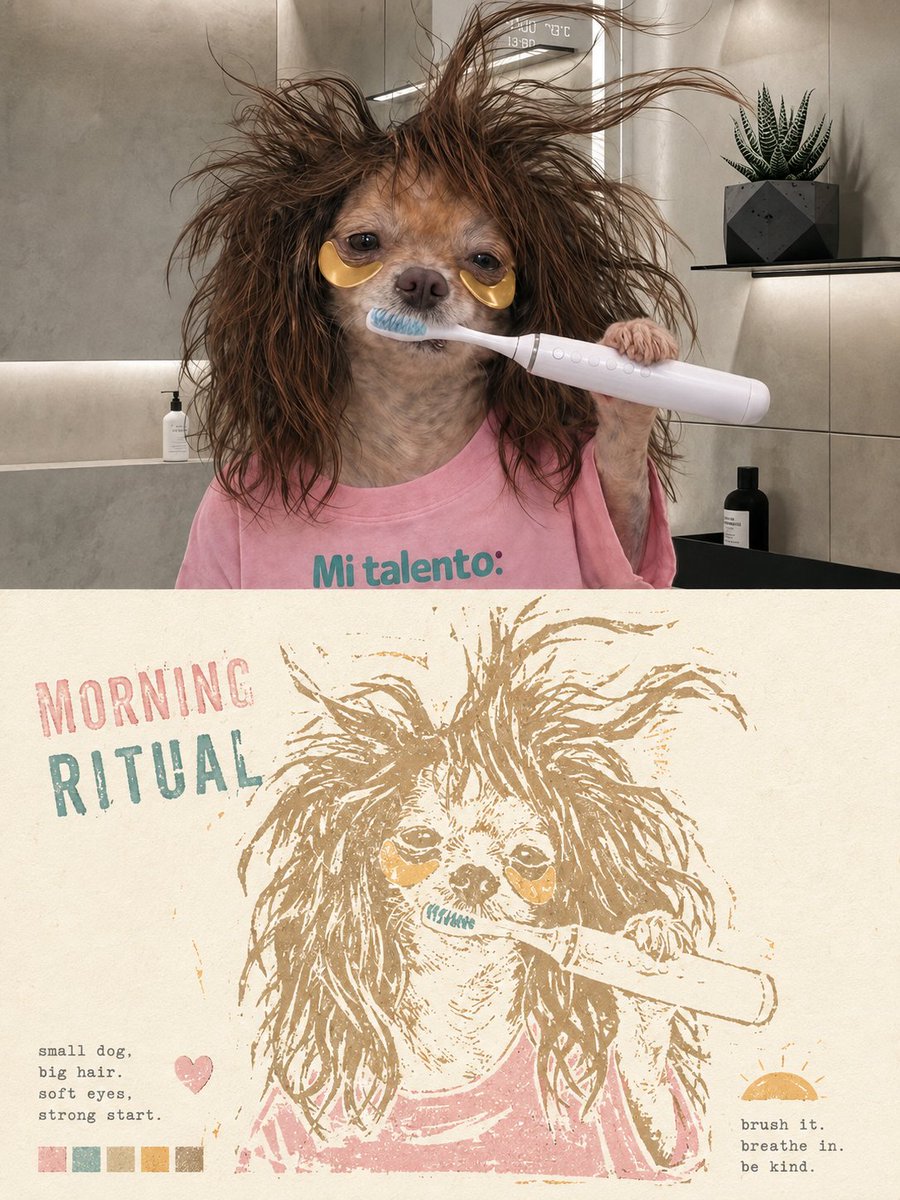
Full prompt
Please create an independent high-end design poster for each photo I upload, with no multi-photo stitching; each photo should be output separately. The overall composition uses a 3:4 vertical layout, with the upper and lower areas strictly at a 1:1 height ratio, each occupying 50% of the frame. The upper part retains the original photo, maintaining the subject's identity, structure, posture, spatial relationships, authentic materials, natural light and shadow, and original color atmosphere, with only slight high-end photographic color grading to give it the texture of an independent magazine, art publication, or exhibition photography. To adapt to the frame, the sky, ground, or environmental background can be naturally extended, but the subject must not be stretched, distorted, mirrored, or altered. The lower part extracts the most recognizable subject, outline, posture, and narrative relationship from the photo, reconstructing it as a limited-color woodcut print mark suspended on paper. Do not directly copy the entire photo or simply apply a filter; instead, actively prune complex backgrounds and trivial details, keeping only the outlines, proportions, directions, light and dark zones, key structures, and core spatial relationships that determine recognizability. Re-summarize the subject using the language of woodcut, linocut, and hand-stamped printing to make it instantly identifiable while possessing a rustic, clumsy, and strongly handcrafted artistic temperament. The graphic brushstrokes should carry the characteristic clumsiness and handmade traces of woodcut prints: lines need not be smooth or precise, allowing for slight hesitations like knife carvings, uneven thickness, fuzzy edges, stiff transitions, local fractures, gaps, misalignments, and irregular negative space; the edges of color blocks can show dry brushing, missing prints, ink shortages, and coarse-grained textures. The overall style is not a refined vector illustration but feels as if it were carved out stroke by stroke with a hand chisel and ink, carrying a simple, direct, slightly naive yet very durable printmaking quality. The composition centers on a single visual anchor point, large areas of negative space, and incomplete edges. Position and scale are determined by the subject's own visual center of gravity, action direction, and structural flow—it can be centered, offset, slightly cropped, or extended in a certain direction. Ample warm paper negative space is preserved around the subject, with edges gradually disappearing through ink gaps, fractured textures, paper transparency, and natural wear, avoiding a complete rectangular border so the image feels like a memory gently pressed onto the paper. The color scheme extracts the most recognizable and vibrant colors from the photo above but transforms them into a 'little fresh,' soft, healing, and bright limited-color logic. Use clean and light comprehensive color systems such as cream white, ivory white, pale pink, misty green, light blue, pale yellow, light orange, mint green, soft coral, and light ochre, maintaining low to medium saturation, high brightness, and soft contrast. Retain the most moving color memory points of the original image but avoid dark, dull, dirty, heavy, and overly retro color schemes. All colors should appear as if matte solid ink were printed layer by layer, soft and clear, yet still retaining the grain and warmth of a print. Text is also integrated as part of the print composition rather than fixed descriptive text. Extract a main title of 1-3 words from the subject's identity, action, emotion, state, location, or metaphor in the photo, paired with a set of very short keywords or a miniature description. The main title can be arranged along the subject's outline, negative space boundaries, visual axes, or print edges, forming a supporting, interleaving, misaligned, or echoing relationship with the graphic; auxiliary small text remains tiny and restrained, using typewriter fonts, monospaced serif fonts, or old-archive-style layouts, like notes in a travel diary or a private print collection. Do not use fixed years; let the text grow naturally based on the photo itself. The overall emphasis is on the rustic handmade feel of woodcut prints, fresh and soft limited colors, paper negative space, incomplete edges, and restrained layout, presenting a warm, quiet, healing, light, nostalgic but not dark high-end print temperament. Whether the subject is a person, animal, plant, architecture, object, vehicle, or natural landscape, a clear and clever visual echo should be maintained between the real photography above and the print reconstruction below, avoiding ordinary filters, complete background replicas, smooth vector outlines, cartoon illustrations, travel template vibes, and cheap retro feelings.
Original prompt
请将我上传的每一张照片分别制作成一张独立的高级设计海报,不多图拼接,每张照片单独输出。整体采用3:4竖版构图,上下两个区域高度严格1:1,各占画面50%。上半部分保留原始照片,保持主体身份、结构、姿态、空间关系、真实材质、自然光影和原有色彩氛围,仅进行轻微高级摄影调色,使其具有独立杂志、艺术出版物和展览摄影质感。为适配画幅,可自然扩展天空、地面或环境背景,但不得拉伸、扭曲、镜像或改变主体。下半部分提取照片中最具识别性的主体、轮廓、姿态与叙事关系,重构为一枚悬浮在纸面上的限色木刻版画印记。不要直接复制整张照片,也不要简单套用滤镜,而是主动删减复杂背景与细碎信息,只保留决定识别度的轮廓、比例、方向、明暗分区、关键结构与核心空间关系,以木刻版画、油毡版画和手工套印的语言重新概括主体,使其一眼可辨,同时具有朴拙、笨拙、手工感强烈的艺术气质。图形笔触要带有木刻版画特有的笨拙感与手作痕迹:线条不必光滑精确,允许出现刀刻般的轻微迟疑、粗细不均、边缘发毛、转折生硬、局部断裂、缺口、错位和不规则留白;色块边缘可呈现干刷、漏印、缺墨和粗颗粒纹理。整体不是精致矢量插画,而是像用手工刻刀和油墨一刀一刀刻印出来,带着朴素、直接、略微稚拙却非常耐看的版画气质。构图以单一视觉锚点、大面积留白和不完整边缘为核心,根据主体自身的视觉重心、动作方向和结构走势决定位置与尺度,可居中、偏置、轻微裁切或沿某一方向延展。主体周围保留充分的温暖纸张留白,边缘通过缺墨、断裂纹理、纸张透底和自然磨损感逐渐消失,避免完整矩形边框,让画面像一段被轻轻压印在纸面上的记忆。配色从上方照片中提取最具辨识度和生命力的颜色,但整体转化为小清新、柔和、治愈、明亮的限色逻辑。采用奶油白、象牙白、浅粉、雾绿、浅蓝、嫩黄、淡橙、薄荷绿、柔和珊瑚色、浅赭色等干净而轻盈的综合色系,保持低至中等饱和度、高明度与柔和对比。保留原图最动人的色彩记忆点,但避免灰暗、沉闷、脏旧、厚重和过度复古的配色。所有颜色应像哑光实体油墨层层套印,柔和清透,却仍有版画的颗粒与温度。文字同样作为版画构图的一部分介入,而不是固定说明文字。从照片的主体身份、动作、情绪、状态、地点或隐喻中提炼一个1–3词的主标题,并搭配一组极短关键词或微型说明。主标题可沿主体轮廓、留白边界、视觉轴线或版画边缘排列,与图形形成承托、穿插、错位或呼应关系;辅助小字保持细小、克制,采用打字机体、等宽衬线体或旧档案式排版,像旅行笔记或私人收藏版画中的注释。不要固定使用年份,让文字根据照片本身自然生长。整体强调木刻版画的朴拙手感、清新柔和的限色、纸张留白、不完整边缘与克制排版,呈现温暖、安静、治愈、轻盈、怀旧而不灰暗的高级版画气质。无论主体是人物、动物、植物、建筑、器物、交通工具或自然景观,都应保持上方真实摄影与下方版画重构之间清晰而巧妙的视觉呼应,避免普通滤镜、完整背景复刻、光滑矢量描边、卡通插画、旅游模板感和廉价复古感。
Use this prompt in the VdoBloom image editor.
Opens the image editor with this prompt — add your own photo to generate.