Japanese Face Diagnosis Report
Full prompt
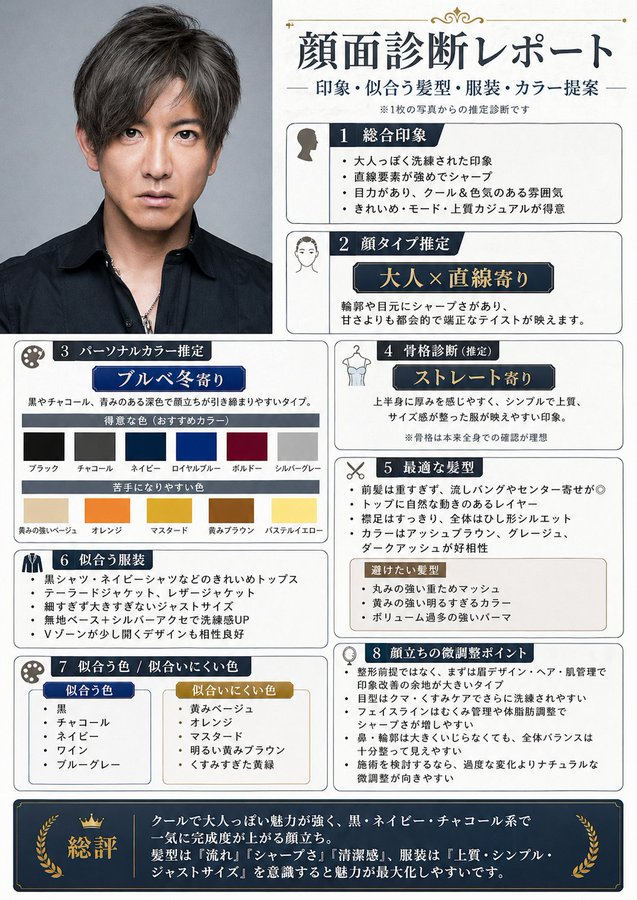
Using REFERENCE_0 as the portrait photo, create a vertical Japanese appearance-consulting diagnosis sheet. Keep the original portrait recognizable and place it cropped on the upper-left side, while adding a clean editorial report layout around it.

Goal: Turn the single portrait into a polished “face diagnosis report” infographic for men, like a professional styling/appearance consultation output.

Canvas and style: Vertical A4-style report, cream/off-white paper background, thin black and gold decorative rules, navy section headers, small simple icons, neat Japanese typography, dense but readable magazine-consulting layout.

Main headline: Use {argument name="headline text" default="顔面診断レポート"} at the top right, with a smaller subtitle below: {argument name="subtitle text" default="印象・似合う髪型・服装・カラー提案"}. Add a tiny note saying it is an estimated diagnosis from one photo.

Layout: Create exactly 8 numbered diagnostic sections plus 1 final summary bar. Arrange them in bordered cards, with the portrait occupying the upper-left column and the analysis cards filling the right side and lower area.

Sections to include, exactly 8:
1. Overall impression: mature, clean, direct gaze, cool and calm atmosphere, suitable for mode/smart casual styling.
2. Face type estimate: “adult × close to straight-line features,” explaining sharp eyes/contours and a balanced elegant impression.
3. Personal color estimate: {argument name="personal color type" default="ブルベ冬寄り"}; include two color rows: recommended deep/high-contrast colors and colors that may be difficult. Show exactly 12 color swatches total: 6 recommended colors labeled black, charcoal, navy, royal blue, burgundy, silver gray; and 6 difficult colors labeled yellowish beige, orange, mustard, yellow-brown, pastel yellow, and a similar warm pale color.
4. Body frame estimate: {argument name="body type" default="ストレート寄り"}; describe a simple, high-quality, just-size outfit impression.
5. Best hairstyle: suggest not too long bangs, center/side part, clean silhouette, ash/gray/dark ash tones, and avoid overly heavy or voluminous perms.
6. Clothing that suits: list clean tops such as black shirt and navy shirt, tailored jackets and leather jackets, slim to just-size silhouettes, and V-neck/open-collar tops.
7. Colors that suit / colors that do not suit: create two small comparison boxes. Suited colors: black, charcoal, navy, wine, blue-gray. Less-suited colors: yellowish beige, orange, mustard, bright yellow-brown, overly pale colors.
8. Subtle improvement points: suggest small grooming and styling adjustments such as eyebrow design, hair volume control, reducing under-eye shadows with concealer, not overdoing face-line changes, maintaining a clean silhouette, and natural skin tone refinement.

Final summary: Add a full-width dark navy bottom summary bar with gold laurel/crown accents and the label {argument name="summary label" default="総評"}. Summarize that cool, mature charm is strong and black/navy/charcoal styling with sharp hair and high-quality simple clothing maximizes the impression.

Constraints: Keep the reference portrait identity and expression unchanged, do not beautify it unrealistically, do not add extra people, do not use English labels in the report, and keep all Japanese text visually plausible and neatly typeset.
Use this prompt in the VdoBloom image editor.
Opens the image editor with this prompt — add your own photo to generate.