Kyoto Memories Corkboard Collage
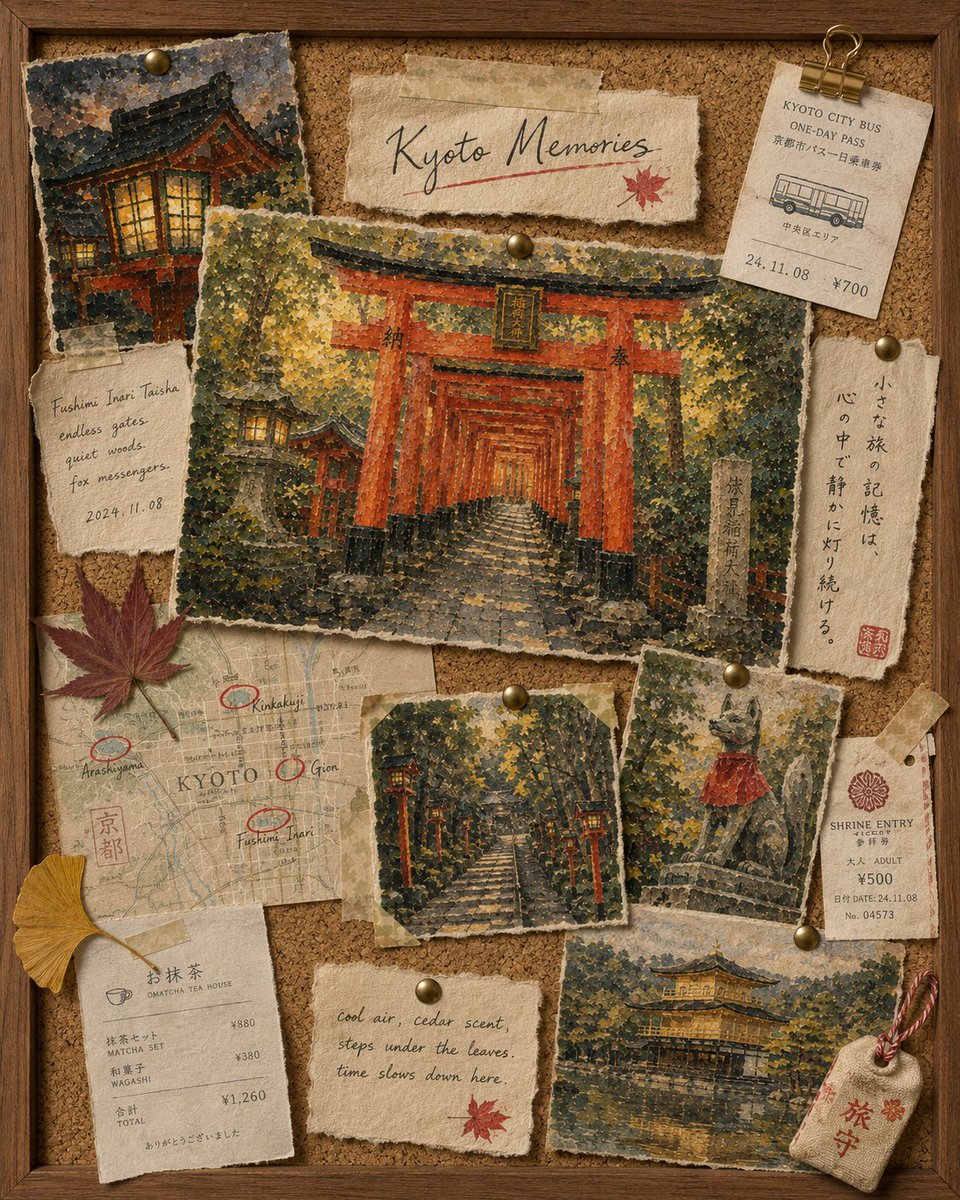
Full prompt
Goal: Create a nostalgic Kyoto travel memory corkboard collage titled {argument name="headline text" default="Kyoto Memories"}, as if made from real paper souvenirs pinned inside a wooden frame.

Canvas: Vertical 4:5 image, warm dim museum-like lighting, realistic corkboard background with a dark wooden frame, soft shadows, antique beige paper textures, torn edges, masking tape, brass pushpins, and binder clips. Overall mood is cozy, handmade, slightly sepia, and autumnal.

Layout: Arrange exactly 12 main pinned or taped items on the corkboard, overlapping naturally:
1. Top-left small painterly postcard of a glowing Kyoto shrine building at dusk, pinned with one brass tack.
2. Top-center torn handmade title strip reading “Kyoto Memories” in elegant handwritten script, underlined in red, with a small red maple leaf stamp.
3. Top-right bus pass ticket clipped with a small brass binder clip, reading “KYOTO CITY BUS / ONE-DAY PASS,” Japanese text, date “24.11.08,” and “¥700,” with a simple bus icon.
4. Center large landscape painting postcard of {argument name="main landmark" default="Fushimi Inari Taisha endless red torii gates"}, showing a stone path receding through many vermilion gates, forest foliage, lantern glow, and textured pointillist brushwork; secure it with two brass tacks.
5. Left-middle torn note with handwritten English text: “Fushimi Inari Taisha / endless gates, / quiet woods, / fox messengers. / 2024.11.08”.
6. Right-middle vertical torn washi note with Japanese calligraphy poem and a small red seal stamp near the bottom.
7. Lower-left folded Kyoto map with red circled destinations labeled Arashiyama, Kinkakuji, Gion, and Fushimi Inari; partially overlapped by a red maple leaf and a yellow ginkgo leaf.
8. Bottom-left tea house receipt labeled “OMATCHA TEA HOUSE,” with small Japanese text, “MATCHA SET ¥880,” “WAGASHI ¥380,” and total “¥1,260”.
9. Lower-center small painterly postcard of a quiet shrine walkway lined with red lanterns, pinned at the top.
10. Lower-right-center small painterly postcard of a fox statue wearing a red bib at a shrine, pinned at the top.
11. Right-lower shrine entry ticket reading “SHRINE ENTRY,” “ADULT,” “¥500,” date “24.11.08,” and ticket number, pinned near the top with a brass tack.
12. Bottom-right painterly postcard of {argument name="secondary landmark" default="Kinkaku-ji Golden Pavilion"} reflected in water, with dark trees and muted golden highlights.

Additional loose objects: Add exactly 3 autumn leaves: one red maple leaf over the map, one yellow ginkgo leaf near the tea receipt, and one small red maple motif stamped on the lower handwritten note. Add exactly 1 small fabric travel charm tag at the bottom-right corner, tied with a red-and-white cord, with Japanese-style characters suggesting a travel amulet.

Visual style: The postcards should look like thick impasto oil or gouache paintings with visible stippled brush marks, rich but muted autumn colors, rough handmade paper borders, and no glossy modern finish. Use warm amber highlights, deep forest greens, vermilion reds, tan paper, brass pins, and dark walnut wood.

Text content: Keep the headline “Kyoto Memories” prominent and legible. Use the date {argument name="travel date" default="2024.11.08"} where handwritten notes or tickets show a date. Include tasteful small Japanese text on tickets and notes, but do not overcrowd the image.

Constraints: Photorealistic physical collage, not a flat graphic design. Preserve the exact count of 12 pinned/taped paper items and 3 autumn leaves. No people, no modern devices, no watermark, no extra headline, no clean digital UI elements.
Use this prompt in the VdoBloom image editor.
Opens the image editor with this prompt — add your own photo to generate.