Perler Bead Pixel Infographic Poster
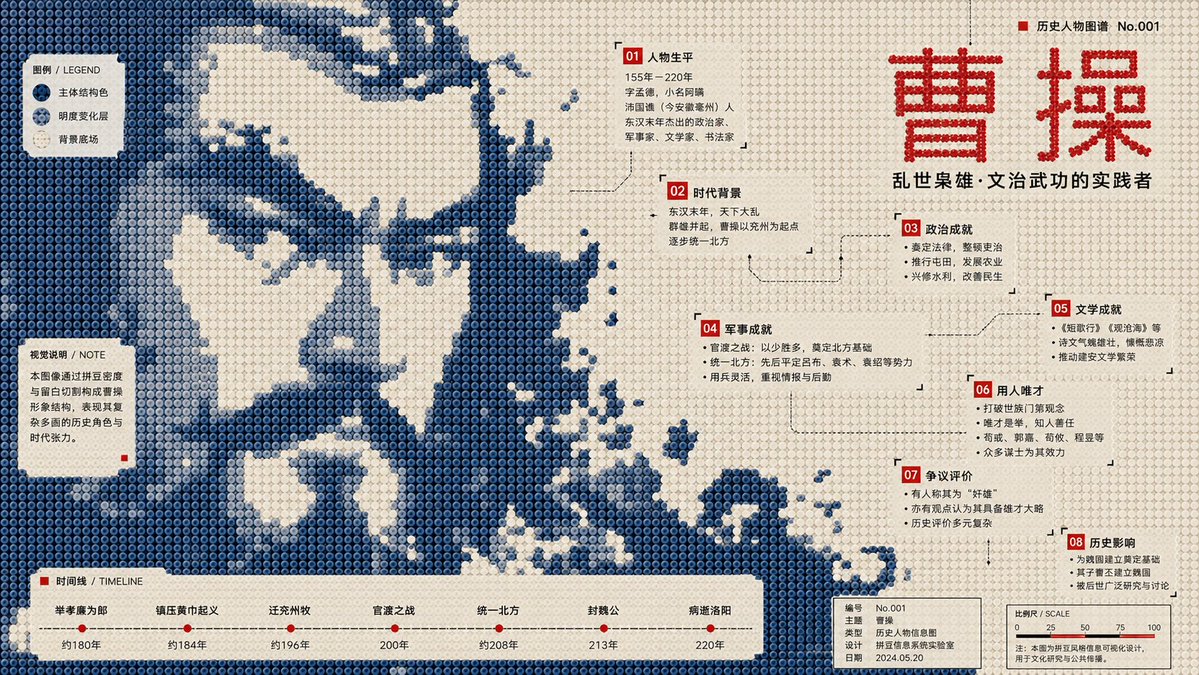
Full prompt
Generate a 16:9 horizontal infographic poster.

Subject: {argument name="subject" default="Pan Jinlian"}

Required Knowledge Points:
[Point 1] through [Point 8]

Visual Style Definition:
This is a structural flat infographic poster in the style of "Perler beads / fuse beads / pixel bead array." The image is composed of a large number of regularly arranged circular plastic beads, each with clear circular boundaries, a slight center indentation, uniform spacing, low-saturation plastic texture, and a stable grid order. The overall composition must maintain a front-view flat layout, resembling a public cultural infographic poster made of beads, rather than toy photography, 3D models, cartoon illustrations, or ordinary pixel art.

Core Composition:
Compress the subject into a large-scale monochromatic bead image field. The subject must surge in from the edges of the frame, crossing page boundaries and being cropped as if a larger bead media image fragment is entering the page. The subject occupies the main visual weight but is not fully presented; viewers must reconstruct the theme through silhouette, direction, missing areas, bead density, and local texture.

Subject Morphology:
The outer edges of the subject exhibit low-resolution bead steps, block fractures, hard-cut gaps, pixelated jagged outlines, missing bead cross-sections, and rough boundaries after sampling. Forbid smooth silhouettes, complete icon outlines, or realistic details. Use only different brightness levels of the same subject structural color within the body to form low-contrast image fragments, halftone noise, scan grains, material afterimages, archival textures, and local density variations.

Background and Negative Space:
The background uses a high-brightness light-colored bead field, close to unprinted paper, light creamy white plastic board, or pale grey-white bead arrays. The background is not a decorative base color but actively cuts back into the subject, forming large voids, winding channels, quiet text windows, reading pause areas, and knowledge point containers. White space must provide a sense of breath while cutting the subject's structure.

Color System:
Adopt a strict three-layer functional color scheme:
1. Light Background Field (60%–70%): Colors like old paper white, light beige, or cold grey-white for breathing and text windows.
2. Subject Structural Color (25%–35%): Defines the subject and mood. Choose based on the subject (e.g., deep blue/dark green for cold themes; ocher red/burnt orange for warm themes).
3. High-Contrast Information Color (3%–6%): Sharp colors like red, black, or bright blue for titles, numbering, and key annotations.

Infographic System:
Transform knowledge points 1 to 8 into bead information nodes (numbered labels, annotation boxes, legend blocks, coordinate lines, etc.). Nodes should be scattered along white space windows, color field boundaries, and subject gaps. Ensure a clear hierarchy of text sizes.

Typography:
Use narrow modern sans-serif fonts or monospace metadata fonts. Text must be arranged in white space windows and bottom information bars, never pressing against the center of the subject.

Bead Material:
All visual elements are made of beads. Surfaces have a matte plastic texture with slight manufacturing irregularities, faint grains, and minor wear. Structural color areas can show halftone-style density changes and a specialty overprint feel.
Original prompt
生成一张 16:9 横版信息图海报。

主题:{argument name="主题" default="潘金莲"}

必须覆盖的知识点:
【知识点1】
【知识点2】
【知识点3】
【知识点4】
【知识点5】
【知识点6】
【知识点7】
【知识点8】

视觉风格定义:
这是一张“拼豆 / Perler beads / fuse beads / 像素珠阵列”风格的结构性平面信息图海报。画面由大量规则排列的圆形塑料拼豆构成,每一颗拼豆都具有清晰圆形边界、轻微中心凹点、均匀间距、低饱和塑料质感和稳定网格秩序。整体必须保持正视平面构图,像一张由拼豆拼成的公共文化信息图海报,而不是玩具摄影、3D模型、卡通插画或普通像素画。

核心构图:
将【主题】主体压缩为一个大尺度单色拼豆图像场,而不是完整写实物体、居中插画或图标集合。主体必须从画幅边缘涌入,跨越页面边界,并被出血裁切,像一个更大的拼豆媒介图像残片进入纸面。主体占据主要视觉重量,但不完整呈现;观众必须通过轮廓、方向、缺失区域、拼豆密度和局部纹理重建主题。

主体形态:
主体外缘呈现低分辨率拼豆台阶、方块断裂、硬切缺口、像素化锯齿轮廓、缺珠断面和被采样后的粗糙边界。禁止平滑剪影,禁止完整图标轮廓,禁止写实细节。主体内部只使用同一主题结构色的不同明度拼豆,形成低对比影像碎片、半调噪声、扫描颗粒、材料残影、档案纹理和局部密度变化。

背景与负空间:
背景使用高明度浅色拼豆底场,接近未印刷纸面、浅奶白塑料底板或淡灰白拼豆阵列。背景不是装饰底色,而是主动反向切入主体,形成大块空洞、曲折通道、安静文字窗口、阅读停顿区和知识点容器。空白必须像空气,也像刀口;它既提供呼吸感,也切割主体结构。大块浅色底与大块主题结构色必须互相侵入,不能简单上下分区,不能成为普通背景。

色彩系统:
采用严格的三层功能配色,不允许平均化配色。

第一层:浅色底场
面积比例约 60%–70%。功能是呼吸、切割、停顿、承载文字窗口。颜色可为旧纸白、浅米白、冷灰白、淡蓝白或淡暖灰。

第二层:主题结构色
面积比例约 25%–35%。功能是构成主体、制造空间压力、表达主题情绪和材料语义。颜色必须根据【主题】选择,例如冷主题可使用深蓝、墨绿、灰紫、石墨色;暖主题可使用赭红、土橙、棕黑、暗金色。结构色内部允许通过拼豆明度差表现颗粒密度和图像残影。

第三层:高对比信息色
面积比例约 3%–6%。功能是标题、编号、时间、注释、机构信息、图例、脚注和关键知识点标记。信息色必须少量、锐利、明确,可使用红、黑、亮蓝、荧光橙或高纯度青色。信息色不能扩散为装饰色。

信息图系统:
将【知识点1】至【知识点8】全部转化为拼豆信息节点,不使用普通图标堆叠解释。每个知识点以以下形式之一呈现:
- 小型编号标签
- 微型注释框
- 拼豆图例块
- 坐标线
- 时间刻度
- 比例条
- 方向箭头
- 档案索引编号
- 局部纹理说明
- 边缘标记点

信息节点必须沿留白窗口、色场边界、切口节点、主体缺口、负空间通道和底部边缘分散布置。信息节点数量为 8 个,对应 8 个知识点。所有信息节点必须有层级关系:主标题最大,核心概念次级,知识点标签更小,脚注 and 编号最小。信息节点不能覆盖主体中心,不能破坏大色场结构。

阅读路线:
构建跳跃式阅读路径:上方小型标记 → 侧向主标题 → 主体边缘知识点 → 负空间注释窗口 → 底部脚注与图例。画面必须同时满足远距离识别和近距离阅读:远看是一个强烈的巨大拼豆图像残片,近看是一个精密、有秩序的知识信息系统。

字体与文字:
使用窄身现代无衬线字体、瑞士风格无衬线、方正清晰骨架字体或等宽元数据字体。字体笔画均匀,字距克制,层级精确。主标题像公共文化信息坐标,小字像档案元数据索引。文字必须排布在留白窗口、边界节点和底部信息栏中,不得压在主体中央。中文文字必须清晰、短句化、标签化,避免长段落。

拼豆材质:
所有视觉元素都由拼豆构成。拼豆表面为哑光塑料质感,带轻微制造不均、微弱颗粒、细小磨损和低对比表面差异。结构色区域内部可出现半调式拼豆密度变化、扫描输出感、旧纸不均匀感和专色叠印感。信息色拼豆必须边缘锐利、对比清楚、定位准确。
Use this prompt in the VdoBloom image editor.
Opens the image editor with this prompt — add your own photo to generate.