Real-Scene Inset Sketch Poster
Full prompt
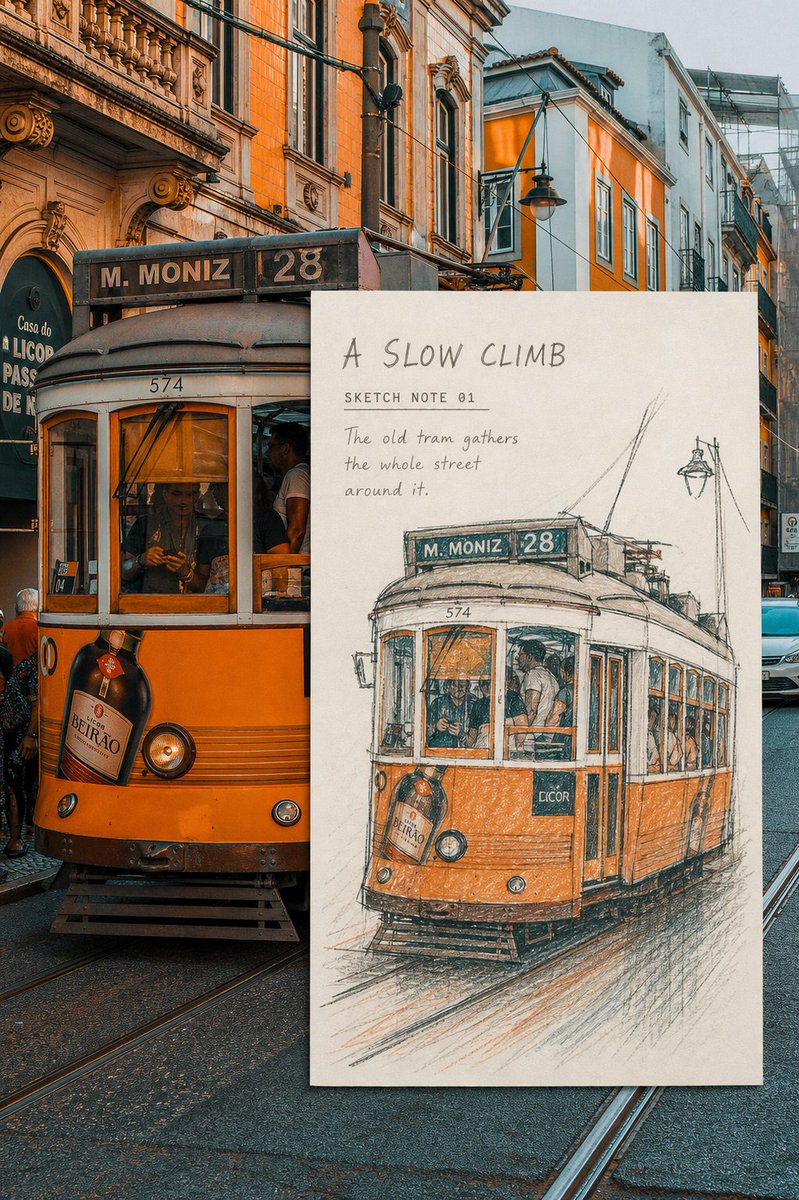
Please turn each of my uploaded travel photos into an independent "Real-life Inlaid Painting Manuscript" work. Each photo should be output separately, and it is forbidden to splice multiple photos into the same image.

Overall adoption of 3:4 vertical composition.

This is not a top-bottom diptych poster, nor a left-right comparison. The original photo should fill the entire frame, and a regular, flat, warm-white drawing paper serves as a real foreground object covering the inside of the photo, so that the real subject in the photo and the manuscript of the same subject on the paper appear simultaneously.

## Original Photo

Completely preserve the identity of the subject, the number of people or animals, postures, movement directions, main clothing colors, vehicle or ship structures, architectural relationships, terrain, observation angles, natural light and shadow, and real textures from the original photo.

The original photo must fill the full frame and remain clearly identifiable, with only slight color toning for art publications, travel magazines, or photography exhibitions, as well as extremely thin film grain.

Do not redraw the original photo into an illustration, move characters, change postures, replace buildings, add or subtract subjects, distort vehicles, or redesign the environment.

## Foreground Paper

Place a regular warm-white rectangular drawing paper inside the photo.

The drawing paper is located between the photo and the viewer, being the foremost layer of the entire frame. People, vehicles, ships, buildings, trees, and other objects in the photo cannot pass in front of the paper, nor can they cover, cut, or block the edges of the paper.

The drawing paper can cover part of the subject or environment of the photo, but enough real subject outlines, clothing, actions, vehicle structures, hulls, roads, or surrounding environments must be preserved outside the paper so that the viewer can see at the same time:
1. The original subject in the real photo;
2. The manuscript transformation of the same subject on the paper.

The drawing paper occupies about 45%–65% of the width and about 38%–58% of the height of the entire frame, placed in the center, left, right, or top area according to the subject position of the original photo.

The drawing paper can use vertical or horizontal proportions, but must meet:
- The four edges are straight, complete, and parallel to each other;
- The four corners are clear and neat;
- The paper proportion is stable;
- It has real but restrained paper fibers;
- Only very thin side thickness;
- Slight contact shadows are generated with the photo.

Prohibit torn edges, raw edges, stamp perforations, irregular die-cuts, curled paper corners, folded paper corners, wavy edges, damaged gaps, photo frames, tablets, or floating digital screens.

## Manuscript on Paper

The painting on the paper must correspond to the same subject and the same moment in the photo.

Accurately extract the most critical aspects of the subject:
- Overall outline;
- Posture and direction of movement;
- Body or object center of gravity;
- Main color of clothing or objects;
- One or two necessary environmental relationship lines.

Characters maintain the posture, orientation, quantity, and relationship to each other in the original photo. Vehicles, ships, and buildings maintain the most important identity structure and direction.

Do not shrink the complete photo and redraw it into the paper, and do not depict all buildings, woods, windows, passers-by, and backgrounds. The paper only retains one main visual anchor and one to three environmental clues.

The main body of the manuscript is concentrated in the lower middle or one side of the paper, and about 45%–70% of the inside of the drawing paper remains unpainted warm-white blank space.

## Painting Medium

Use travel sketch language with obvious hand-made traces:
- loose colored pencil;
- expressive markers;
- minimalist outlines;
- light watercolor washes;
- elegant line art;
- high-fashion sketch.

Through the above techniques, it shows a relaxed, high-end, and minimalist artistic atmosphere.
Original prompt
请将我上传的每一张旅行照片分别制作成一张独立的“实景嵌画手稿”作品。每张照片单独输出,禁止把多张照片拼接在同一画面中。

整体采用3:4竖版构图。

这不是上下双联海报,也不是左图右图对比。原始照片应铺满整张画面,一张规则、平整的暖白色绘画纸作为真实前景物件覆盖在照片内部,使照片中的真实主体与纸上的同主体手稿同时出现。

## 原始照片

完整保留原始照片中的主体身份、人物或动物数量、姿态、动作方向、服装主色、车辆或船只结构、建筑关系、地形、观察角度、自然光影和真实材质。

原照片必须铺满全幅并保持清楚可辨,只进行轻微的艺术出版物、旅行杂志或摄影展调色,以及极薄的胶片颗粒。

不得把原照片重画成插画,不得移动人物、改变姿态、替换建筑、增减主体、扭曲车辆或重新设计环境。

## 前景画纸

在照片内部放置一张规则的暖白色矩形绘画纸。

画纸位于照片与观者之间,是整个画面的最前层。照片中的人物、车辆、船只、建筑、树木和其他物体都不能穿到纸张前面,也不能覆盖、切断或遮住纸张边缘。

画纸可以遮住照片主体或环境的一部分,但纸张外部必须保留足够的真实主体轮廓、服装、动作、车辆结构、船体、道路或周边环境,使观者能够同时看到:

1. 真实照片中的原始主体;
2. 纸张上对同一主体的手稿转绘。

画纸占整张画面宽度约45%–65%、高度约38%–58%,根据原照片主体位置放置在中央、偏左、偏右或偏上区域。

画纸可以使用竖向或横向比例,但必须满足:

- 四条边笔直、完整并互相平行;
- 四个角清楚、规整;
- 纸张比例稳定;
- 具有真实 but 克制的纸张纤维;
- 只有极薄的侧边厚度;
- 与照片之间产生轻微接触阴影。

禁止撕纸边、毛边、邮票齿孔、异形模切、卷曲纸角、折叠纸角、波浪边、破损缺口、相框、平板电脑或悬浮数字屏幕。

## 纸上手稿

纸张上的绘画必须对应照片中的同一主体和同一个瞬间。

准确提取主体最关键的:

- 整体轮廓;
- 姿态与动作方向;
- 身体或物体重心;
- 服装或物件主色;
- 一至两条必要环境关系线。

人物保持原照片中的姿态、朝向、数量及彼此关系。车辆、船只和建筑保持最重要的身份结构和方向。

不要把完整照片缩小后重新画进纸张,也不要描绘所有建筑、树林、窗户、路人和背景。纸面只保留一个主要视觉锚点及一至三条环境线索。

手稿主体集中在纸面中下部或一侧,画纸内部约45%–70%保持未经绘制的暖白色留白。

## 绘画媒介

使用具有明显手工痕迹的旅行速写语言:

- loose colored pencil;
- expressive markers;
- minimalist outlines;
- light watercolor washes;
- elegant line art;
- high-fashion sketch.

通过以上技法展现出一种松弛、高级感且极简的艺术氛围。
Use this prompt in the VdoBloom image editor.
Opens the image editor with this prompt — add your own photo to generate.