Torn Edge Ink Memory Poster
Full prompt
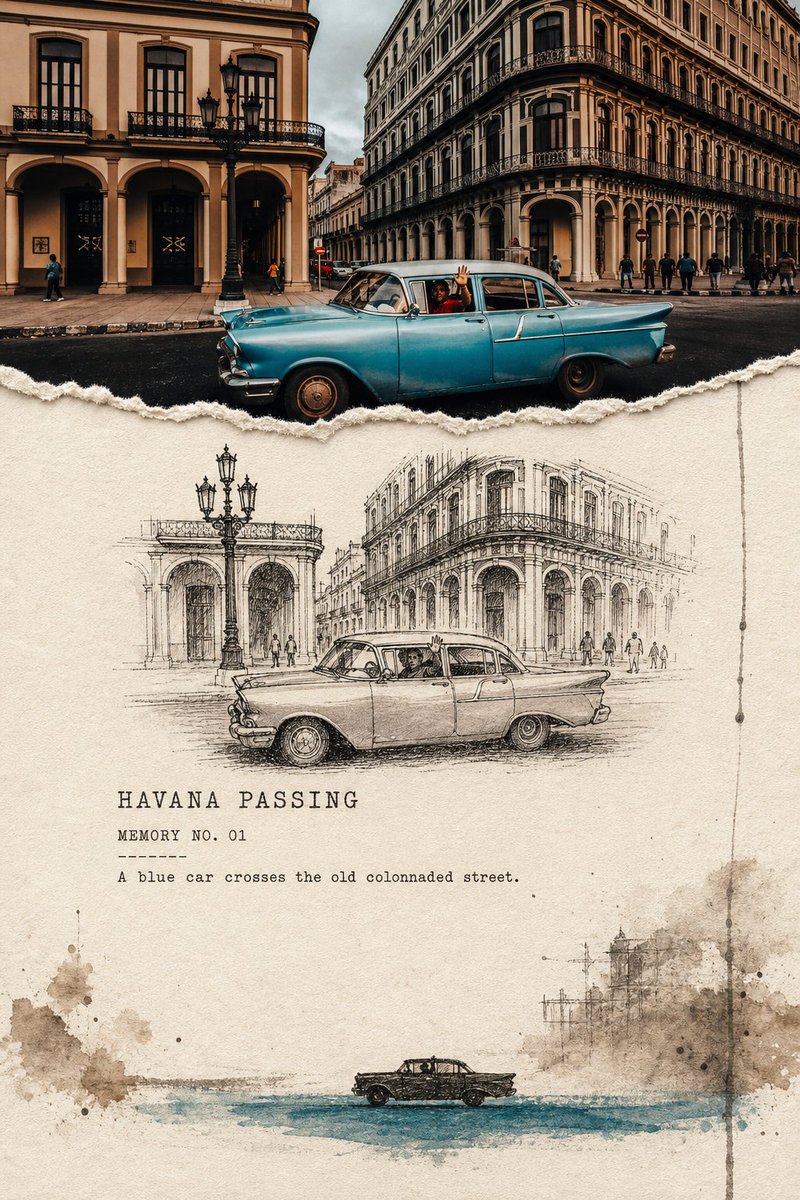
Please create an independent torn-edge ink memory edit poster for each travel photo I upload, with each photo output separately and no multi-image stitching. Use a 3:4 vertical layout overall, employing a three-stage diminishing structure of "real photography -> observation line drawing -> ink silhouette" to express the same scene. The top part occupies about 28%-36% of the frame height, faithfully preserving the most important scene from the original photo. Accurately maintain the identity, number, posture, orientation, spacing, architectural structure, vehicles, boats, animals, human actions, real textures, spatial directions, natural light and shadow, and iconic colors of the subjects, with only slight artistic publication color grading. The photo must be clearly recognizable and cannot be stylized as an illustration or turned into a decorative thumbnail. The top photo and the paper below are connected using clearly visible hand-torn paper edges: the edges should have real paper fibers, irregular bumps, and slight thickness, and must not use digital atomization, feathering, or soft-light gradients. The middle section is warm ivory, unbleached cotton paper, or light beige coarse paper, serving as the observation page with the most white space. Redraw the same subject using unstable pen lines, short cross-hatching, dry ink, and a small amount of gray wash, accurately preserving the number, posture, and relative position while actively deleting irrelevant backgrounds and tiny details. Select tree trunks, lighthouses, bridge cables, architectural edges, ship masts, mountain cracks, or vehicle outlines from the photo as a vertical memory anchor. Line drawings should be concentrated in a narrower horizontal field, not filling the paper or acting as automatic photo outlines. The bottom section lets the scene dissipate further into ink blobs of light taupe, ash, blue-gray, or olive black, uneven water marks, dry brush grains, slender broken lines, and 1-2 restrained drips. The subject shrinks into a group of small dark silhouettes, still maintaining the correct number and orientation, landing on a horizontal brushstroke of an accent color extracted from the original photo. Use only one accent color, not fixed to orange. Information density must decrease from top to bottom: the photo is the densest, the line drawing is second, and the bottom silhouette is the simplest. Maintain continuous, obvious breathing space on the paper in the middle and around the subjects; ink blobs flow in incompletely from one side or the bottom edge, not closing all four sides. In the middle white space, add a 1-3 word English title, a MEMORY NO. 01 style field, and a 5-10 word English observation sentence. Use readable typewriter bold, monospaced archival fonts, or uppercase block letters with ink gaps for the text; auxiliary text is smaller but should not shrink into gray lines. Text content must derive from the subjects, actions, weather, or spatial relationships in the photo, not copying the author's text or fabricating research data. The overall look should be like a page of a travel archive that has been torn, observed, and is gradually fading—restrained, poetic, with real paper fiber, dry ink, and a sense of time. Mandatory Avoidance: Hard vertical/horizontal boundaries, common half-photo half-sketch templates, digital softening transitions, irrelevant illustrations below, full-page watercolors, traditional ink landscape imitations, cute cartoons, detailed animal or plant manuals, automatic outlines, dense technical infographics, large titles overwhelming the image, multiple accent colors, author names, signatures, accounts, logos, URLs, QR codes, watermarks, and garbled characters.
Original prompt
请将我上传的每一张旅行照片分别制作成一张独立的撕边墨迹记忆编辑海报,每张照片单独输出,不多图拼接。整体采用3:4竖版,使用“真实摄影→观察线稿→墨迹剪影”三阶段递减结构表达同一场景。顶部约占画面高度28%–36%,忠实保留原始照片中最重要的场景。准确保持主体身份、数量、姿态、朝向、间距、建筑结构、车辆、船只、动物、人物动作、真实材质、空间方向、自然光影和标志性色彩,只进行轻微艺术出版物调色。照片必须清楚可辨,不能插画化或变成装饰性缩略图。顶部照片与下方纸面使用清楚可见的手工撕纸毛边连接:边缘有真实纸纤维、不规则凹凸与轻微厚度,不能使用数字雾化、羽化或柔光渐变。中部为温暖象牙色、未漂白棉纸或浅米色粗纸,是留白最多的观察页。用不稳定钢笔线、短排线、干墨和少量灰洗重画同一主体,准确保留数量、姿态和相对位置,但主动删除无关背景与微小细节。选择照片中的树干、灯塔、桥索、建筑边缘、船桅、山体裂隙或车辆轮廓作为一条竖向记忆锚点。线稿集中在较窄的水平场域,不铺满纸面,也不做照片自动描边。底部让场景进一步消散成淡灰褐、烟灰、蓝灰或橄榄黑的墨团、不均匀水痕、干笔颗粒、细长断线和1–2道克制滴落。主体缩成一组小型深色剪影,仍保持正确数量和方向,落在一道从原照片提取的强调色水平笔迹上。只使用一个强调色,不固定为橙色。信息密度必须自上而下递减:照片最密,线稿次之,底部剪影最简。中部和主体周围保留连续、明显的纸面呼吸空间;墨团从一侧或下缘不完整地涌入,不封闭四边。在中部留白加入一个1–3个英文单词标题、MEMORY NO. 01式字段和一行5–10个英文单词观察句。文字使用可读的打字机粗体、等宽档案字或带缺墨的大写铅字,辅助文字较小但不能缩成灰线。文字内容必须来自照片中的主体、动作、天气或空间关系,不复制作者文字,不虚构研究数据。整体应像一页被撕开、观察并逐渐褪去的旅行档案,克制、诗意,具有真实纸纤维、干墨与时间感。强制避免:硬直上下分界、普通半照片半速写模板、数字柔化过渡、无关下方插画、满页水彩、传统水墨山水模仿、可爱卡通、精细动物或植物图鉴、自动描边、密集技术信息图、大标题压过画面、多种强调色、作者名、签名、账号、Logo、网址、二维码、水印、乱码。
Use this prompt in the VdoBloom image editor.
Opens the image editor with this prompt — add your own photo to generate.